

23 Jan Why Easter’s Date Changes Every Year (The Ancient Formula Revealed)
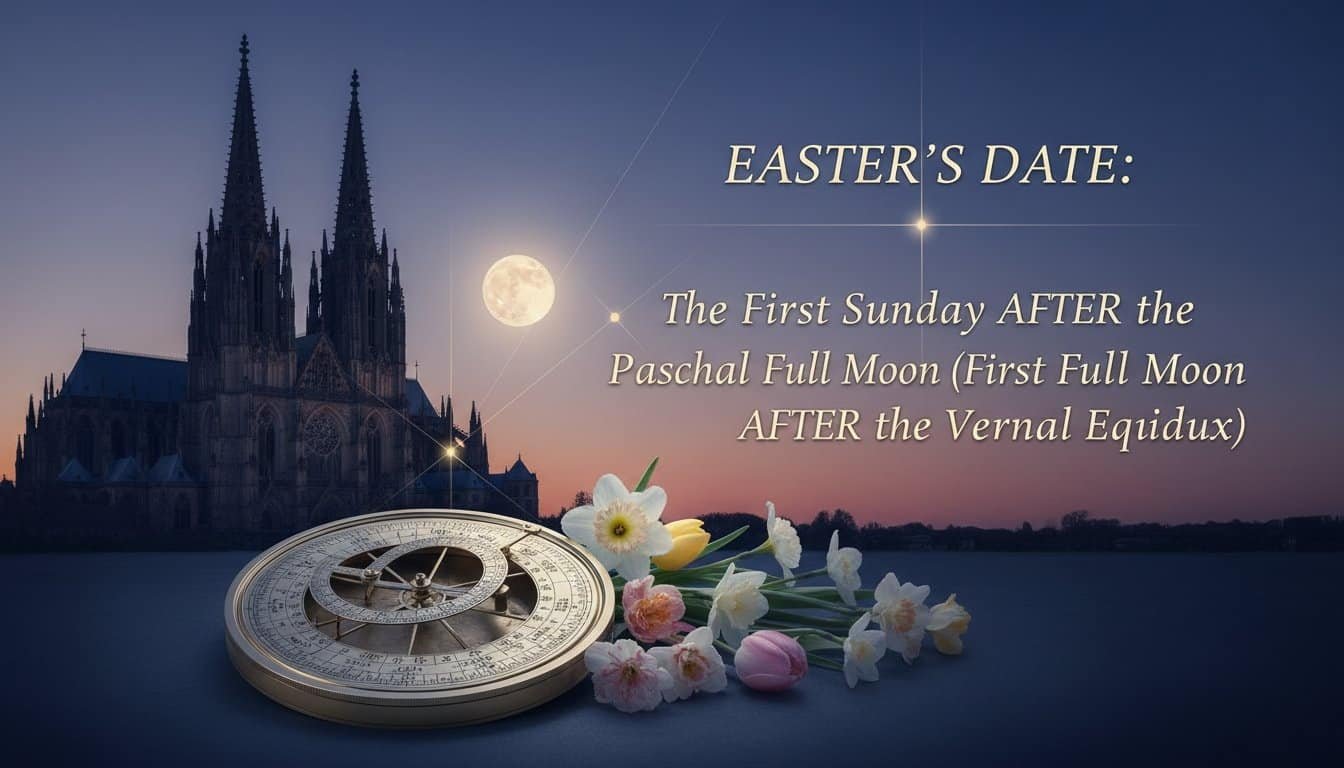
Easter’s date changes annually because you’re following a 1,700-year-old lunar formula established by the Council of Nicaea in 325 CE. You’ll find Easter falls on the first Sunday after the Paschal full moon, which occurs on or after March 21st. This ancient computus deliberately connects Christianity’s holiest celebration to Jewish Passover’s lunar calendar rather than fixed solar dates. The complex calculations involve epacts, Golden Numbers, and the 19-year Metonic cycle to synchronize lunar and solar rhythms—revealing fascinating mathematical precision behind this sacred timing.
Table of Contents
Key Takeaways
- Easter falls on the first Sunday after the Paschal full moon occurring on or after March 21.
- The Council of Nicaea in 325 CE established the computus paschalis formula linking Easter to lunar cycles.
- Easter’s lunar dependency causes dates to shift annually within a range from March 22 to April 25.
- The ancient formula ties Easter to Jewish Passover and the spring equinox using astronomical calculations.
- The 19-year Metonic cycle and epact system mathematically track lunar ages to determine Easter’s date.
Why Does Easter Change Dates Every Year?

Why does Christianity’s most significant celebration shift across a five-week span each year while Christmas remains fixed on December 25? You’ll find the answer lies in Easter’s dependence on lunar calculations rather than solar ones. Unlike Christmas, which follows the Gregorian calendar’s solar year, Easter’s date derives from ancient Hebrew traditions tied to Passover and the spring equinox.
The early Church established that Easter must fall on the first Sunday after the Paschal full moon, which occurs on or after March 21. This lunar dependency creates the annual variation you observe. The moon mechanics involve complex astronomical cycles, particularly the 19-year Metonic cycle where lunar phases repeat almost exactly.
These two word discussion ideas—lunar versus solar—explain why Easter can fall anywhere between March 22 and April 25. The mathematical approximations used in modern Easter calculations preserve this ancient astronomical relationship while accommodating our solar-based calendar system. However, Orthodox churches may celebrate Easter on a different day due to their use of alternative calendar systems and lunar calculation methods.
How the Moon Controls Easter’s Calendar
How does an ancient celestial body dictate when billions of Christians celebrate their faith’s most sacred day? You’re witnessing an unlikely alliance between lunar astronomy and ecclesiastical mathematics that’s endured for seventeen centuries.
The Paschal Full Moon serves as Easter‘s primary anchor point—specifically, the first ecclesiastical full moon occurring on or after March 21. However, this isn’t the actual astronomical full moon you’d observe in the sky. Instead, church calculations employ what scholars call “lunar fudge”—deliberate mathematical approximations that prioritize calendar consistency over astronomical accuracy.
Through the epact system, ecclesiastical authorities track lunar ages mathematically, determining when this critical full moon occurs. Easter then falls on the first Sunday following this calculated lunar event. This method explains why your Easter celebration shifts dramatically between late March and late April each year, controlled entirely by an ancient formula that intentionally diverges from real celestial observations.
The Ancient Formula That Calculates Easter
What mathematical principles could transform centuries of Easter disputes into a unified calculation system? The Council of Nicaea in 325 AD established the computus paschalis, creating a standardized formula that you can still use today. This ancient system determines Easter as the first Sunday following the paschal full moon on or after March 21, producing dates from March 22 to April 25.
You’ll find the formula relies on three critical components: the golden number ((Y mod 19) + 1), which tracks your year’s position in the 19-year Metonic cycle; the dominical letter, calculated through Gregorian adjustments; and the epact method for lunar age calculations. While an unrelated topic might seem more accessible, this mathematical precision prevented the tangential aside of conflicting Easter celebrations across Christianity. Gauss’s 1800 algorithm refined these calculations further, enabling you to compute Easter dates centuries in advance using pure integer arithmetic.
Why Eastern and Western Easter Dates Differ
Where did the centuries-old divide between Eastern and Western Easter celebrations originate? You’ll find the answer lies in calendar systems adopted centuries apart. When Pope Gregory XIII corrected the Julian calendar’s 11-minute annual drift in 1582, Western churches embraced the Gregorian system while Eastern Orthodox churches maintained Julian calculations for religious observances.
This fundamental split creates compounding differences. You’re seeing Western churches use the actual vernal equinox (March 20-21 Gregorian), while Eastern traditions fix it to March 21 Julian—now 13 days behind astronomical reality. These aren’t calendar myths or lunar folklore, but precise computational divergences affecting Easter’s calculation.
Eastern churches also preserve the biblical requirement that Pascha follow Jewish Passover, while Western Christianity abandoned this constraint. The Eastern Paschal full moon typically occurs four days later than Western calculations, though in certain years within the 19-year cycle, this gap extends to 34 days due to Gregorian adjustments.
The Golden Number System Behind Easter Math
Behind these calendar complexities lies a sophisticated mathematical framework that has governed Easter calculations for over fifteen centuries. You’ll find the Golden Number at its foundation—a system ranking each year within the 19-year Metonic cycle of 235 lunations. This number determines when ecclesiastical new moons occur, ensuring lunar and solar calendars realign predictably.
To calculate your year’s Golden Number, you’d divide the year by 19, then add 1 to the remainder. From this, scholars derive the Epact—the moon’s age on January 1st—using the formula (11 × (Golden Number – 1)) mod 30. The Epact then pinpoints the Paschal Moon date, which ranges from March 25 to April 18.
Once you’ve established the Paschal Moon, Easter Sunday follows on the next Sunday. This ancient astronomical system demonstrates how medieval mathematicians solved complex calendar synchronization challenges that still govern Easter calculations today.
What Corrections Keep Easter Calculations Accurate
How do centuries-old mathematical systems maintain their precision across millennia of astronomical drift? You’ll find that Easter’s accuracy depends on sophisticated correction mechanisms built into the Gregorian reform of 1582.
Mathematical precision endures through centuries via sophisticated astronomical correction mechanisms, as demonstrated by the Gregorian calendar’s intricate Easter calculation system.
The original Julian calendar couldn’t compensate for lunar drift, requiring Pope Gregory XIII’s astronomers to introduce epact corrections that realign the paschal full moon with the vernal equinox. You’re essentially using a system where century factor b = year/100 introduces solar corrections, while variables d, e, and f adjust for leap year discrepancies and Gregorian leap omissions.
Gauss’s algorithm underwent multiple refinements between 1800-1816, replacing complex modular calculations with simpler conditional statements. The computus method abandoned real lunar observation for arithmetic approximations, fixing the vernal equinox at March 21 regardless of astronomy.
These corrections prevent Easter from drifting into what early Christians considered the pagan month periods, maintaining the festival’s spring timing across centuries.
When Easter Falls on the Same Date Worldwide
You’ll witness a remarkable convergence when Western and Orthodox Christians celebrate Easter simultaneously, an event that occurs approximately once every five to six years due to complex astronomical calculations.
The next unified celebration will happen in 2025, following the synchronized observance in 2017 that demonstrated how different calendar systems can occasionally align despite their fundamental mathematical differences.
This rare alignment results from the intricate interplay between Gregorian and Julian calendar calculations of the Paschal full moon, creating unpredictable synchronization patterns that require year-by-year computational analysis.
Rare Calendar Alignment
When might Christians worldwide celebrate Easter on precisely the same date? You’ll witness this rare phenomenon in 2025, when Easter falls on April 20 for both Eastern and Western churches.
This convergence isn’t unrelated topic material or random date trivia—it represents a profound astronomical and calendrical alignment occurring after centuries of divergence.
The 13-day disparity between Julian and Gregorian calendars typically separates Eastern Orthodox and Western celebrations by weeks. However, 2025’s alignment results from the Paschal full moon and spring equinox coinciding on both calendar systems. This marks only the second such occurrence since 2017, highlighting the rarity of these moments.
Remarkably, this convergence coincides with the 1,700th anniversary of the Council of Nicaea, which originally standardized Easter calculations in 325 CE.
Next Unified Celebration
Where will the next opportunities arise for Christians worldwide to celebrate Easter simultaneously? You’ll witness unified celebrations on April 16, 2028, followed by April 13, 2031, and April 9, 2034. These alignments occur at irregular intervals due to complex lunar-solar calendar interactions between Gregorian and Julian systems.
The ecumenical symbolism of these shared dates carries profound significance for Christian unity. Church leaders like Pope Francis and Patriarch Bartholomew I view these moments as pivotal opportunities for denominational reconciliation. You’re observing what amounts to alternate history scenarios—brief glimpses of what Christianity might’ve looked like had the 325 Council of Nicaea’s unified vision persisted.
Each alignment represents more than mathematical coincidence; it’s a temporary restoration of the original ecclesiastical intent for universal Easter celebration across all Christian traditions.
Easter Dates for the Next Decade
How might these complex calculations translate into actual calendar dates for the coming years? You’ll observe significant variability in Western Easter dates from 2026-2035, demonstrating the ancient formula‘s mathematical precision. Easter will fall on April 5 (2026), March 28 (2027), April 16 (2028), April 1 (2029), April 21 (2030), April 13 (2031), March 28 (2032), April 17 (2033), April 9 (2034), and March 31 (2035).
This sequence illustrates the 35-day range established by the Council of Nicaea’s methodology. You’ll notice March 28 repeats in 2027 and 2032, reflecting the complex interaction between lunar cycles and solar years. Unlike unrelated topic discussions or random trivia about holidays, these dates result from rigorous ecclesiastical computations spanning centuries. The golden number and epact calculations ensure each date represents the first Sunday after the Paschal Full Moon, maintaining Christianity’s foundational connection to ancient astronomical observations while preserving liturgical consistency across global congregations.
Frequently Asked Questions
Can Easter Ever Fall on the Same Date Two Years in a Row?
No, Easter dates can’t fall on the same date in consecutive years.
You’ll find that calculation methods incorporating the 19-year Metonic cycle, solar corrections, and lunar adjustments prevent identical dates.
The computus formula ensures weekday shifts of 1-2 days annually due to the 365.25-day solar year misalignment with lunar phases.
Historical analysis from 326-4099 AD confirms you won’t encounter back-to-back identical Easter dates.
What’s the Earliest and Latest Possible Dates Easter Can Occur?
Easter’s earliest possible date is March 22, while the latest is April 25, establishing a 35-day range. You’ll find these boundaries stem from the oldest full masting calculations established at Nicaea in 325 AD.
The lunar cycle challenges create this variability—when March’s full moon coincides with the equinox and falls on Saturday, you’ll see March 22. Conversely, late April dates occur when the paschal moon appears in mid-April.
Why Don’t All Christian Churches Celebrate Easter on the Same Day?
You’ll find Christian churches don’t celebrate Easter simultaneously because Eastern Orthodox churches retained the Julian calendar while Western churches adopted the Gregorian reform in 1582. This creates different calculations for the spring equinox and lunar cycles. Eastern churches base their Paschal determination on Julian calendar Eastern moons, while Western churches use Gregorian calculations. Consequently, Sunday timing varies between traditions, perpetuating the centuries-old liturgical division despite shared apostolic origins.
How Did the Council of Nicaea Decide on Easter’s Calculation Method?
You’ll find the Council of Nicaea established Easter’s calculation method in 325 CE by combining solar and lunar elements. The council decided Easter dates would follow the first Sunday after the first full moon occurring on or after March 21’s vernal equinox. This standardized formula addressed variations across churches that had previously used different calculation methods, creating the unified system that determines Easter’s annual date changes today.
Will Easter’s Calculation Formula Ever Need to Be Updated Again?
You’ll likely see Easter’s calculation formula updated eventually, though not soon. The current ecclesiastical approximations will gradually diverge from actual astronomical alignment over centuries. New computation methods could replace traditional tables by 4100 AD when current formulas reach their limits. Additionally, you might witness revisions if Christian denominations pursue unified Easter dates or if accumulated calendar drift demands correction for maintaining astronomical accuracy.
Conclusion
You’ve discovered that Easter’s shifting date stems from a complex astronomical calculation rooted in ancient Christian tradition. You’ll find this lunar-solar formula, established at the Council of Nicaea in 325 CE, continues governing Easter’s placement today. You’re witnessing centuries-old mathematical precision that balances lunar cycles with solar calendars. When you examine future Easter dates, you’re observing the enduring legacy of early ecclesiastical astronomy that’s shaped Christian worship for nearly seventeen hundred years.












No Comments