

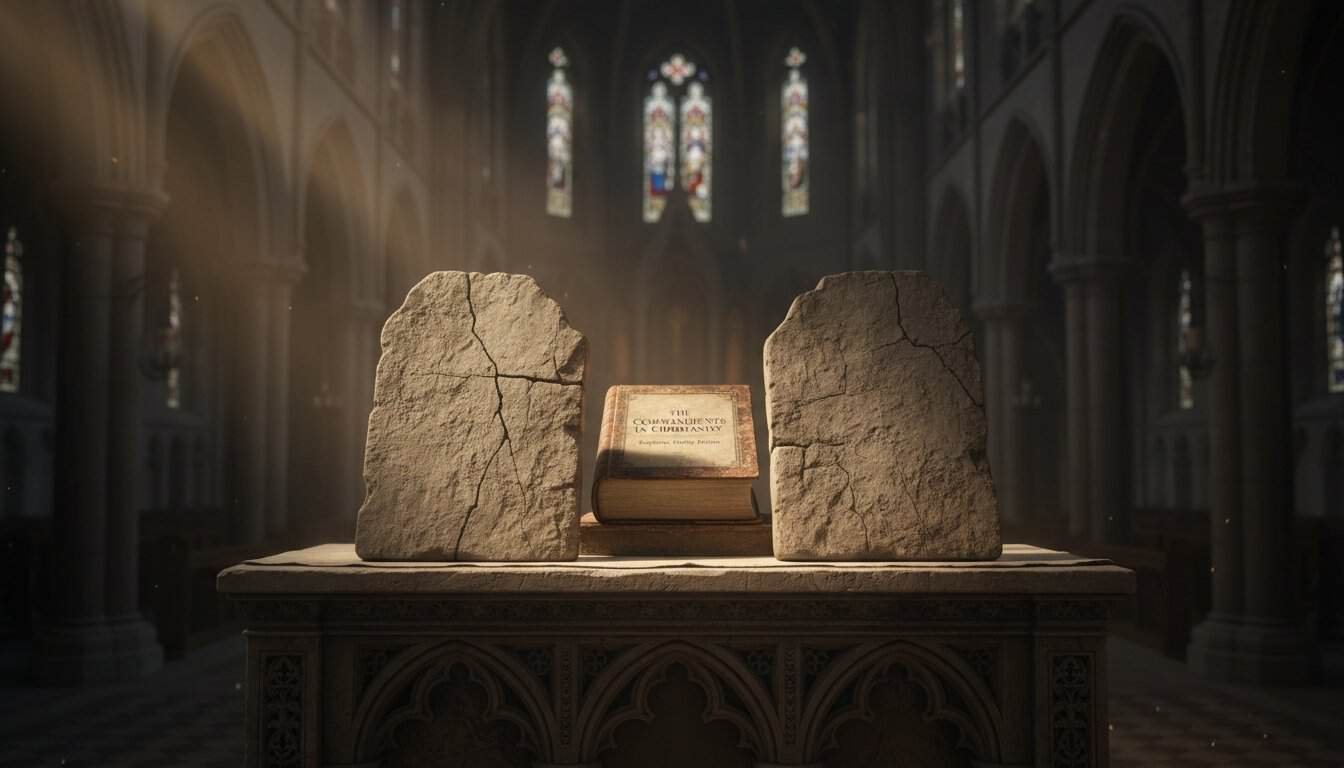
16 Dec The 10 Commandments in Christianity Scripture, History, Practice
You’ll find Christianity’s Ten Commandments originated at Mount Sinai when God spoke these divine laws directly to Moses, establishing fundamental principles for worship and righteous living. These commandments demand exclusive worship of God, prohibit idolatry, require reverence for His name, and mandate Sabbath observance. They also protect human life’s sanctity, uphold marital faithfulness, defend property rights, demand truthfulness, and call for contentment over covetousness. Understanding their theological depth reveals how these ancient principles continue shaping Christian ethics today.
Key Takeaways
- God gave Moses the Ten Commandments at Mount Sinai, establishing the foundational moral law for Israel and later Christianity.
- The first four commandments focus on humanity’s relationship with God: monotheism, rejecting idolatry, honoring God’s name, and observing Sabbath.
- Commandments five through nine govern human relationships: honoring parents, preserving life, marital faithfulness, honest property rights, and truthful testimony.
- The tenth commandment addresses internal attitudes by prohibiting covetousness, revealing that God’s law examines both behavior and heart motives.
- Christians interpret these commandments through Christ’s teachings, emphasizing both moral guidance and the need for grace through redemption.
Biblical Origins and Divine Revelation at Mount Sinai

When God summoned Moses to Mount Sinai approximately fourteen centuries before Christ, He established the foundational moral law that would govern His covenant relationship with Israel and subsequently influence all of human civilization. You’ll find this pivotal moment recorded in Exodus 19-20, where Yahweh descended upon the mountain amid thunder, lightning, and thick clouds. The ancient Israelites witnessed God’s awesome presence as He spoke the Ten Commandments directly to Moses, who’d serve as mediator between the divine and human realms.
This theophanic encounter wasn’t merely a moral instruction session—it constituted the heart of the Mosaic covenant. You’re observing God’s gracious initiative to establish a holy nation set apart for His purposes. The Decalogue emerged from this covenant relationship, not as arbitrary rules, but as divine wisdom reflecting God’s character and His design for human flourishing within the covenant community.
The First Commandment: Worship of the One True God
You encounter in the First Commandment God’s foundational declaration: “You shall have no other gods before me” (Exodus 20:3), which establishes absolute monotheism as Christianity’s bedrock principle.
This divine mandate directly challenged the polytheistic worldview that dominated ancient Near Eastern cultures, where multiple deities competed for human allegiance and worship. You must understand that rejecting idolatry isn’t merely avoiding physical statues, but recognizing that anything you place above God’s rightful position constitutes a violation of this primary commandment.
Monotheism in Ancient Context
While ancient Near Eastern cultures embraced polytheistic pantheons with multiple deities governing different spheres of life, the first commandment—”You shall have no other gods before me” (Exodus 20:3)—established Israel’s radical departure into strict monotheism.
You’ll find that surrounding polytheistic traditions worshipped gods like Baal, Asherah, and Marduk, each controlling specific domains such as fertility, war, or weather. Ancient near eastern religions typically organized deities hierarchically, with supreme gods ruling lesser ones.
Israel’s covenant with Yahweh demanded exclusive allegiance, rejecting this pluralistic framework entirely. This wasn’t merely henotheism—acknowledging other gods while worshipping one—but absolute monotheism declaring Yahweh as the only true God. You’re witnessing humanity’s first systematic rejection of polytheistic worldviews in favor of singular divine authority.
Rejecting Idolatry and Polytheism
Though Yahweh’s declaration “You shall have no other gods before me” appears straightforward, this foundational commandment encompasses both the prohibition of rival deities and the complete rejection of idolatrous worship practices that dominated ancient Near Eastern religion. You’ll find this directive cuts deeper than surface-level theological preference—it demands exclusive covenant loyalty to Israel’s God alone.
The commandment directly confronts ancient polytheism’s hierarchical pantheons, where multiple deities governed different spheres of existence. Unlike neighboring cultures that accommodated various gods through syncretistic practices, you’re called to recognize Yahweh’s singular sovereignty. This prohibition extends beyond pagan idol worship to encompass any created thing that usurps God’s rightful place in your devotion, establishing the theological foundation for pure monotheistic faith.
The Second Commandment: Prohibition Against Idolatry and Graven Images
As God’s voice thundered from Mount Sinai, the second commandment established a fundamental boundary between true worship and false religion: “You shan’t make idols” (Exodus 20:4, ESV). This prohibition extends beyond mere prohibition of art to encompass any created object that becomes an object of veneration or worship.
You’ll find this commandment specifically targets worship of graven images—carved, molded, or crafted representations intended to embody divine presence. The Hebrew term “pesel” refers to carved idols, while “temunah” encompasses any likeness or form.
God’s concern isn’t artistic expression itself, but rather the human tendency to worship created things instead of the Creator. This commandment protects God’s transcendence and uniqueness. You can’t contain the infinite God within finite materials. When you bow before images, you’ve reduced the incomprehensible Creator to comprehensible objects, fundamentally distorting His nature and misdirecting worship that belongs to Him alone.
The Third Commandment: Reverence for God’s Holy Name

When Moses received the third commandment—”You shan’t take the name of the Lord your God in vain” (Exodus 20:7, ESV)—God established His name as sacred territory requiring reverent treatment. This directive encompasses more than avoiding profanity; it demands reverence for God’s name in all contexts.
The Hebrew term “shav” (vain) means emptiness or worthlessness, indicating you mustn’t use God’s name carelessly, falsely, or without purpose. This includes false oaths, empty promises made in God’s name, and frivolous invocation of divine authority.
Jesus reinforced this principle, teaching disciples to pray “Hallowed be your name” (Matthew 6:9), emphasizing sanctification of God’s reputation.
Honoring God’s reputation extends beyond speech to conduct. When you claim Christ’s name, your actions reflect His character. Paul warns that God’s name can be blasphemed through inconsistent behavior (Romans 2:24). Therefore, reverence for God’s name requires both careful speech and faithful living that upholds His holy reputation.
The Fourth Commandment: Observance of the Sabbath Day
While humanity operates under relentless productivity pressures, the fourth commandment—”Remember the Sabbath day, to keep it holy” (Exodus 20:8, ESV)—establishes God’s counter-cultural rhythm of work and rest. You’re commanded to cease regular labor for one day weekly, mirroring God’s creation pattern where He rested on the seventh day (Genesis 2:2-3).
Sabbath day observance encompasses both cessation from work and devotion to worship. The Hebrew word “Sabbath” means “to cease” or “rest,” indicating complete discontinuation of ordinary activities.
You’ll find that Jesus clarified Sabbath principles, emphasizing mercy over legalistic restrictions (Matthew 12:7).
Christian sabbath day traditions vary significantly. While some maintain Saturday observance following Jewish practice, most Christians observe Sunday, commemorating Christ’s resurrection. Reformed traditions emphasize worship attendance and spiritual reflection, while avoiding recreational activities. Contemporary interpretations focus on restoration, family time, and worship participation, recognizing the Sabbath as God’s gift for human flourishing rather than burdensome obligation.
The Fifth Commandment: Honor and Respect for Parents
From God’s rhythm of rest, the commandments shift to foundational relationships within human society, beginning with the family unit. The Fifth Commandment declares, “Honor your father and your mother, that your days may be long upon the land which the Lord your God is giving you” (Exodus 20:12). This commandment establishes filial piety as fundamental to covenant community.
You’re called to honor parents through respect, obedience, and care throughout their lives. Hebrew “kabbed” means “to give weight” or “treat as weighty,” indicating parents deserve reverence beyond childhood. Paul reinforces this principle, calling it “the first commandment with promise” (Ephesians 6:2-3).
Generational respect creates stable societies where wisdom transfers from old to young. You honor parents by valuing their guidance, providing for their needs in aging, and maintaining respectful communication. This commandment extends to all authority figures representing parental roles, establishing hierarchical order that reflects divine authority structure within human relationships.
The Sixth Commandment: The Sanctity of Human Life
You’ll find the Sixth Commandment’s prohibition “You shan’t murder” (Exodus 20:13) establishes the fundamental principle that human life bears divine image and inherent sanctity. Throughout Christian history, theologians have distinguished between unlawful killing (murder) and justifiable taking of life in contexts such as self-defense, just war, and capital punishment, creating nuanced interpretative frameworks.
Today’s ethical challenges—including abortion, euthanasia, and genetic engineering—demand you apply these biblical foundations and historical interpretations to contemporary questions about life’s beginning, end, and manipulation.
Biblical Foundation and Text
The sixth commandment, “You shan’t murder” (Exodus 20:13, ESV), establishes God’s fundamental prohibition against the unlawful taking of human life. You’ll find this directive repeated in Deuteronomy 5:17, where Moses restates the Decalogue to Israel’s second generation.
Ancient manuscripts consistently preserve the Hebrew term “ratsach,” which specifically denotes unlawful killing rather than all forms of taking life. This distinction appears crucial when you examine biblical texts that permit capital punishment and warfare under divine sanction.
The commandment’s placement within the Decalogue underscores humanity’s inherent dignity as bearers of God’s image (Genesis 1:27). You’re called to recognize that this prohibition extends beyond mere physical violence to encompass attitudes and actions that diminish human worth and dignity in God’s sight.
Historical Christian Interpretations
Early Church Fathers developed nuanced interpretations of the sixth commandment that shaped Christian understanding for centuries. You’ll find Augustine distinguishing between murder and justified killing, establishing principles that influenced medieval theology significantly.
Thomas Aquinas’s scholastic interpretations refined these distinctions further, arguing that the commandment prohibited unlawful killing while permitting capital punishment and just war under specific conditions.
You can trace how patristic writers like John Chrysostom emphasized the commandment’s broader application to anger and hatred, not merely physical violence. Medieval theologians expanded this framework, developing comprehensive moral theology around life’s sanctity. These interpretations created doctrinal foundations that continue influencing Christian ethics today, demonstrating how scriptural commands require careful theological reflection to address complex moral situations throughout history.
Modern Ethical Applications
Contemporary debates around abortion, euthanasia, and capital punishment have brought the sixth commandment‘s prohibition against murder into sharp focus within modern Christian ethics. You’ll find denominations wrestling with ethical dilemmas that require careful biblical exegesis and theological reasoning.
Protestant traditions generally emphasize Scripture’s teaching that humans bear God’s image (Genesis 1:27), making life inherently sacred. Catholic doctrine maintains consistent life ethics from conception to natural death, while Orthodox Christianity similarly upholds life’s sanctity through patristic teachings.
Applied Christianity demands you consider both biblical principles and pastoral realities when addressing end-of-life decisions, self-defense, and war. These contemporary applications reveal how ancient commandments remain relevant, requiring faithful interpretation that honors both divine revelation and human dignity in complex moral landscapes.
The Seventh Commandment: Marital Faithfulness and Sexual Purity
When God declared “You shan’t commit adultery” in Exodus 20:14, He established a foundational principle that extends far beyond the prohibition of extramarital sexual relations. This commandment encompasses God’s design for human sexuality within the covenant of marriage, emphasizing both marital trust and sexual discipline as essential components of faithful living.
Scripture consistently affirms marriage as the exclusive context for sexual intimacy (Hebrews 13:4). Jesus expanded this understanding in Matthew 5:27-28, revealing that adultery begins in the heart through lustful thoughts. The apostle Paul reinforces this teaching in 1 Corinthians 6:18-20, declaring that sexual immorality violates the believer’s identity as God’s temple.
Contemporary applications include maintaining emotional boundaries, practicing sexual purity in singleness, and fostering covenant faithfulness in marriage. This commandment calls you to honor God’s design for sexuality while recognizing that sexual sin, like all transgression, finds forgiveness through Christ’s redemptive work.
The Eighth Commandment: Honesty and Property Rights
While the seventh commandment protects the sacred bonds of marriage and sexual purity, the eighth commandment shifts focus to another fundamental aspect of human relationships: respect for property and truthful dealings. “You shan’t steal” (Exodus 20:15) establishes divine protection for property ownership rights and honest commerce.
Scripture reveals theft encompasses more than taking physical objects. You’re violating this commandment through fraud, withholding wages (James 5:4), dishonest business practices, or misrepresenting products. The Hebrew word “ganab” implies secretive taking, emphasizing deception’s role in theft.
This commandment upholds social order by preventing theft and establishing trust between individuals. You’re called to honest labor (Ephesians 4:28) and generous sharing rather than coveting others’ possessions. Early church practices in Acts 2:44-47 demonstrate proper stewardship while respecting individual ownership.
Christian ethics demand you protect others’ property as diligently as your own, fostering communities built on integrity and mutual respect.
The Ninth and Tenth Commandments: Truth-Telling and Contentment
As the Ten Commandments draw to their conclusion, the ninth and tenth commandments address internal motivations that drive external violations of God’s law. You shan’t give false testimony against your neighbor” (Exodus 20:16) and “You shan’t covet” (Exodus 20:17) target the heart’s deceptions and desires that corrupt relationships and community life.
The ninth commandment encompasses more than courtroom perjury. It prohibits gossip, slander, and deceptive speech that damages others’ reputations. Truth telling practices require you to verify information before speaking, consider your motives, and protect others’ dignity. Jesus emphasized this principle when He declared Himself “the truth” (John 14:6).
Truth telling demands we verify information, examine our motives, and safeguard others’ dignity before we speak.
The tenth commandment addresses covetousness—the internal longing for what belongs to others. This desire fuels theft, adultery, and murder. Cultivating contentment becomes essential Christian discipline. Paul modeled this: “I have learned to be content whatever the circumstances” (Philippians 4:11).
These commandments reveal that God’s law penetrates beyond external behavior to examine your heart’s attitudes and motivations.
Frequently Asked Questions
How Do the Ten Commandments Differ Between Catholic and Protestant Traditions?
You’ll find interpretation variations primarily in the numbering system between Catholic and Protestant traditions. Catholics follow Augustine’s division, combining coveting commandments into one while splitting idolatry prohibitions.
Protestants typically use Reformed numbering, separating graven images as distinct commandments. These denominational differences reflect theological emphases rather than scriptural contradictions, as both traditions draw from identical Exodus 20:1-17 and Deuteronomy 5:4-21 passages in their doctrinal frameworks.
What Role Do the Commandments Play in Modern Christian Salvation Theology?
You’ll find commandments serve different functions in salvation theology application depending on denominational commandments interpretation.
Protestant traditions typically view them as moral guides that reveal sin’s nature, driving you toward grace-based salvation rather than earning it.
Catholic theology sees them as both revealing God’s will and participating in sanctification alongside faith.
Orthodox Christians emphasize theosis through commandment observance. They don’t save you but guide faithful living.
How Do Different Christian Denominations Interpret Commandment Violations and Forgiveness?
You’ll find Catholic and Orthodox traditions emphasize sacramental grace approaches, requiring confession and absolution for serious commandment violations.
Protestant denominations typically stress direct forgiveness through Christ’s atonement, though they maintain church discipline practices for persistent sin.
Reformed churches often implement formal disciplinary procedures, while Pentecostal movements emphasize repentance and restoration.
Each tradition balances Matthew 18:15-17‘s correction process with doctrinal understandings of justification and sanctification.
Are Christians Required to Follow Old Testament Laws Beyond the Commandments?
You’re not bound to Old Testament laws beyond moral commandments, as Christ fulfilled the Law (Matthew 5:17).
Paul clarifies you’re freed from ceremonial regulations including dietary requirements (Romans 14:17, Colossians 2:16-17).
While you respect governmental authority per Romans 13, you’re not subject to ancient Israel’s civil governance structures.
The Jerusalem Council confirmed Gentile believers aren’t obligated to follow Mosaic ceremonial law (Acts 15:28-29).
How Do the Commandments Relate to Jesus’s Teachings in the Sermon?
You’ll find Jesus directly addresses the commandments in the sermon on the mount through commandment fulfillment rather than abolishment. He declares he’s come to fulfill the law, then intensifies several commandments—prohibiting not just murder but anger, not just adultery but lustful thoughts.
You’re witnessing Jesus revealing the commandments’ deeper spiritual intent, demonstrating how his teachings complete rather than replace Old Testament moral law.
Conclusion
You’ve encountered God’s eternal moral law that transcends cultural boundaries and historical epochs. These commandments aren’t merely ancient regulations but divine principles that Christ fulfilled and believers must internalize through the Spirit’s power. As you apply these precepts, you’re participating in God’s covenant relationship, reflecting His holiness in contemporary discipleship. They remain Christianity’s moral foundation, guiding your worship, relationships, and ethical conduct according to Scripture’s unchanging truth and apostolic teaching.












No Comments