


04 Nov What Is the Best Bible Verse Lookup Tool?
You’ll find BibleHub excels for parallel translations and Strong’s Concordance integration, while Blue Letter Bible offers superior morphological parsing of Hebrew stems (קַל, פִּעֵל, הִפְעִיל) and Greek verb forms. For mobile accessibility, YouVersion provides 2,600+ versions across 1,700+ languages. Serious exegetes benefit from Logos‘s syntactical databases parsing construct chains and articular infinitives, though free platforms like BibleHub match many premium features. Your specific needs—whether tracking λόγος variants or comparing Masoretic-Septuagint readings—determine which tool transforms your biblical research.
Key Takeaways
- Advanced morphological search filters enable precise grammatical analysis of Hebrew stems and Greek verb forms across multiple manuscript traditions.
- Strong’s Concordance integration with unique numbering system tracks every word occurrence throughout Scripture for comprehensive lexical study.
- Critical apparatus access from NA28 and BHS displays textual variants and manuscript evidence for scholarly textual criticism.
- Boolean operators and proximity searches locate specific word combinations and thematic connections beyond simple keyword matching.
- Parallel text comparison displays multiple Bible translations simultaneously alongside original language texts for translation analysis.
Essential Features Every Bible Verse Lookup Tool Should Have

When you’re searching for biblical texts across multiple translations and manuscripts, you’ll need a lookup tool that provides more than basic word searches. Advanced search filters should enable you to isolate specific grammatical constructions, Hebrew stems (qal, piel, hiphil), and Greek verb forms (aorist, perfect, imperfect). You’ll want access to textual variants from critical apparatuses like NA28 and BHS, allowing comparison of manuscript traditions.
Effective verse tagging systems let you categorize passages by theological themes, literary genres, and historical periods. Look for tools that support original language searches using Unicode Hebrew and Greek characters, not just transliterations. Cross-reference capabilities should link parallel passages, quotations, and allusions throughout the canon.
The interface must handle complex Boolean operators for precision searching while maintaining intuitive navigation. Integration with lexicons like BDAG and HALOT proves essential for serious exegetical work. Finally, you’ll need export functions that preserve formatting for academic citations.
BibleGateway: The Most Popular Online Bible Search Platform
When you’re navigating BibleGateway‘s robust search features, you’ll discover its keyword functionality extends beyond simple English queries to include Strong’s Concordance numbers, enabling direct searches for Hebrew terms like חֶסֶד (hesed) or Greek words like ἀγάπη (agape).
You can access over 200 Bible translations in 70+ languages, ranging from critical editions like the NA28 Greek text to ancient versions including the Latin Vulgate and Syriac Peshitta.
The platform’s integration with study tools connects your searches to commentaries from patristic sources through modern scholarship, lexicons, and parallel text comparisons that illuminate the textual variants crucial for serious exegetical work.
Key Search Features
The advanced search function lets you explore Strong’s numbers directly, connecting to lexical roots without knowing the original languages.
You’ll find the “match all word forms” option invaluable for tracking verbal stems across conjugations, especially when studying thematic developments through historical-critical lenses or investigating intertextual connections between Septuagint readings and Masoretic traditions.
Available Bible Translations
Beyond specialized search capabilities, BibleGateway‘s extensive translation library offers over 200 versions in 70+ languages, making it particularly valuable for comparing manuscript traditions and translation philosophies.
You’ll find formal equivalence translations like NASB alongside dynamic translations such as NLT, which prioritize thought-for-thought rendering over word-for-word correspondence.
The platform includes gender inclusive editions like NRSV and CEB, reflecting contemporary debates over translating Hebrew ‘adam and Greek anthropos.
You can examine critical editions based on Nestle-Aland’s Greek text alongside those following the Textus Receptus.
BibleGateway’s parallel view feature lets you compare up to five translations simultaneously, revealing how different translators handle ambiguous constructs like the Hebrew waw-consecutive or Greek aorist tense.
This breadth enables you to trace interpretive decisions across translation committees and manuscript families.
Study Tools Integration
While BibleGateway’s translation library forms its foundation, the platform’s integrated study tools transform casual reading into systematic exegesis through features that connect Scripture with linguistic analysis and historical commentary.
You’ll find the study sync functionality particularly valuable when examining passages requiring deeper theological investigation, as it coordinates multiple resources simultaneously across your selected texts.
The resource linking system connects Strong’s Concordance numbers directly to Greek and Hebrew lexicons, enabling you to trace word usage throughout Scripture.
When you’re analyzing Romans 3:25, for instance, you can instantly access the semantic range of ἱλαστήριον (hilastērion) and its Septuagint connections to the mercy seat in Exodus 25:17.
These integrated commentaries from scholars like F.F. Bruce and N.T. Wright provide historical-critical perspectives alongside archaeological insights, enriching your understanding of first-century Palestinian contexts.
Blue Letter Bible: Best for Original Language Study and Word Analysis
Serious students of Scripture who want to dig beneath English translations will find Blue Letter Bible indispensable for accessing the original Hebrew and Greek texts. You’ll discover comprehensive Greek lexicon insights through Strong’s Concordance integration, allowing you to examine every occurrence of a word throughout Scripture. The platform’s interlinear feature displays the original text alongside transliteration and parsing information, revealing grammatical nuances that English can’t capture.
When you’re researching textual criticism, Blue Letter Bible provides access to manuscript variants, showing differences between the Textus Receptus, Nestle-Aland, and other critical texts. You can trace how κοινή Greek words evolved in meaning from classical usage through the Septuagint to New Testament contexts. The tool’s morphological analysis breaks down verb tenses, moods, and voices, while Hebrew resources include pointing and cantillation marks. Cross-references to ancient commentaries and patristic writings add historical depth to your exegesis.
YouVersion Bible App: Top Mobile Solution for Verse Discovery

You’ll find YouVersion’s search functionality supports multiple query types including keyword, phrase, and reference searches across 2,600+ Bible versions in 1,700+ languages—far exceeding the multilingual capabilities of traditional print concordances like Strong’s or Young’s Analytical.
The app’s offline reading feature lets you download complete texts in their original languages (including Nestle-Aland 28 for Greek and BHS for Hebrew) alongside your preferred translations, ensuring uninterrupted study even without internet connectivity.
While it lacks the morphological parsing depth of desktop solutions like Accordance or Logos, YouVersion compensates through its vast translation library and cross-referencing system that connects parallel passages across the biblical canon.
Core Search Features
Navigate YouVersion’s robust search architecture to access biblical texts across multiple translations and manuscripts with unprecedented precision. You’ll discover search speed that processes queries across 2,600+ versions in milliseconds, leveraging cloud-based indexing that rivals academic databases like BDAG and Nestle-Aland apparatus tools.
Your query filters enable targeted exploration through Hebrew lemmas (שָׁמַע), Greek roots (ἀγάπη), and contextual parameters matching scholarly concordances. The platform’s result ranking algorithm prioritizes textual relevance using weighted frequencies similar to critical editions’ apparatus criticus methodology.
You can exploit fuzzy matching capabilities that recognize transliteration variants, diacritical marks, and morphological forms—essential when tracking Septuagint variations or Masoretic Text discrepancies. This mirrors the search precision of specialized tools like Accordance or Logos while maintaining accessibility for non-specialists studying manuscript traditions.
Offline Reading Options
Beyond cloud-dependent search architectures lies YouVersion’s comprehensive offline infrastructure, engineered to preserve full textual access without network connectivity—a critical feature when conducting field research or studying in regions with limited digital infrastructure.
You’ll find the integrated offline concordance maintains Strong’s numbering system references, enabling Hebrew and Greek lexical analysis without internet dependency. The platform’s portable commentaries include Matthew Henry’s exposition and archaeological annotations from the ESV Study Bible, compressed through efficient data algorithms.
When you’re examining παράκλητος (paraklētos) variations across Johannine literature or tracking הֶסֶד (chesed) occurrences throughout covenant narratives, the cached database preserves search functionality.
Downloaded translations retain critical apparatus markers, manuscript variant notations, and cross-reference chains—essential tools for serious textual criticism whether you’re in metropolitan libraries or remote archaeological sites.
Bible Hub: Comprehensive Resource for Parallel Translations and Commentaries
Bible Hub stands as a premier digital repository that synthesizes multiple biblical translations, lexical tools, and exegetical commentaries into a unified platform for serious textual study. You’ll find its translation comparison feature invaluable when examining textual variants across manuscripts, displaying up to 50 versions simultaneously for any given passage.
The platform’s parallel commentaries integrate classical expositors like Matthew Henry alongside contemporary scholars, enabling you to trace interpretive traditions through centuries. You’ve got immediate access to Strong’s Concordance numbers, parsing data, and transliterated Greek (Koine) and Hebrew (Masoretic) texts. When you’re investigating hapax legomena or disputed readings, Bible Hub‘s interlinear function reveals word-for-word translations with morphological tags.
The site’s lexicon entries connect to Thayer’s, Brown-Driver-Briggs, and Gesenius’ Hebrew dictionaries, providing etymological roots and semantic ranges. You can cross-reference the Septuagint with the Hebrew text, examining how Hellenistic Jews understood passages that New Testament authors later quoted.
Logos Bible Software: Professional-Grade Tool for Serious Scholars
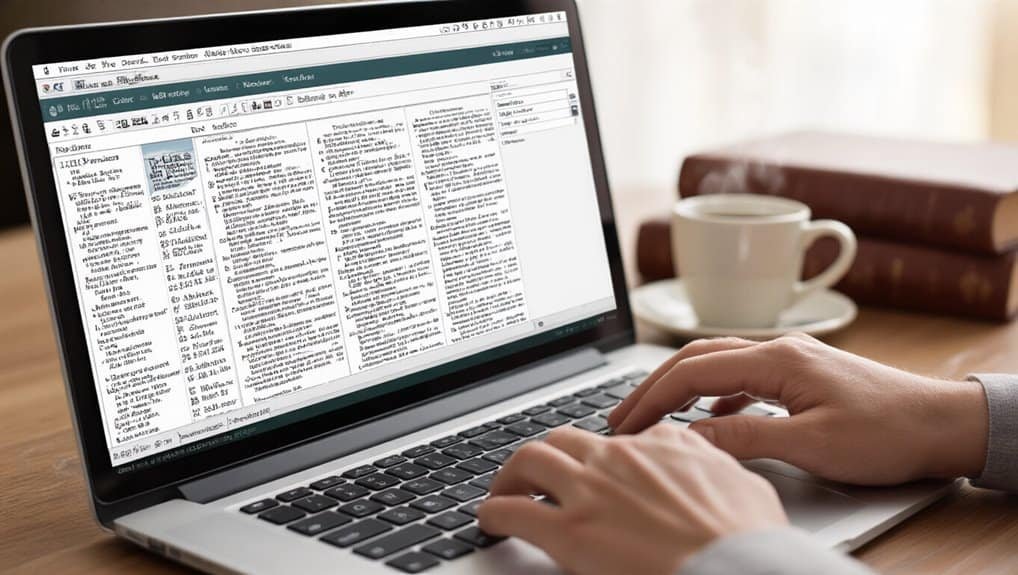
When you’re conducting serious exegetical work that demands syntactical analysis of Hebrew construct chains or Greek participles, Logos Bible Software‘s advanced search capabilities let you query across morphologically tagged texts with Boolean operators and proximity searches.
You’ll access original language tools that parse every word form, display apparatus criticus variants, and link to lexicons like BDAG and HALOT directly from the biblical text.
The software’s library integration features synchronize your personal theological collection—from Patristic sources to Dead Sea Scrolls manuscripts—allowing cross-referencing between primary texts and scholarly commentaries within seconds.
Advanced Search Capabilities
As you delve deeper into Logos Bible Software‘s search architecture, you’ll discover capabilities that transcend simple keyword matching through its proprietary syntax-aware engine that parses Greek lemmas, Hebrew roots, and semantic domains simultaneously.
You can execute contextual queries that identify grammatical constructions like the Hebrew infinitive absolute or Greek articular infinitives across manuscript traditions. The platform’s proximity operators enable you to locate phrases where χάρις appears within five words of πίστις, revealing Paul’s theological framework.
You’ll leverage morphological searches to trace the evolution of terms from the Septuagint through the New Testament, examining how δικαιοσύνη shifted in meaning between Hellenistic Jewish and early Christian contexts.
These tools let you analyze discourse markers, identify hapax legomena, and map semantic ranges across biblical corpora with scholarly precision.
Original Language Tools
Exegetical precision demands mastery of Logos’s original language apparatus, which integrates morphologically-tagged texts of the Nestle-Aland 28th edition, the Biblia Hebraica Stuttgartensia, and the Rahlfs-Hanhart Septuagint within a unified analytical framework.
You’ll access critical apparatus notes displaying manuscript variants from Codex Sinaiticus, Vaticanus, and Alexandrinus alongside Byzantine textual traditions.
The software’s textual criticism tools let you evaluate διαφοραί (differences) between witnesses, tracing transmission histories through stemmatic relationships.
When you’re parsing δικαιοσύνη or analyzing the qal perfect of ברא, Logos provides instant grammatical breakdowns, semantic domain classifications, and hapax legomena identification.
You can compare the Masoretic Text against Dead Sea Scrolls readings, examining ketiv-qere distinctions and evaluating ancient versional evidence.
The platform’s syntactical databases illuminate Hebrew construct chains and Greek participial constructions, revealing nuances invisible in translation.
Library Integration Features
Beyond the granular analysis of individual texts, Logos’s library integration features transform your entire theological collection into a seamlessly interconnected research ecosystem.
You’ll discover how library APIs enable cross-referencing between lexicons, commentaries, and primary sources when examining terms like δικαιοσύνη (righteousness) or חֶסֶד (covenant loyalty). The software’s catalog interoperability connects your physical and digital holdings, synchronizing bibliographic data across platforms.
When you’re researching Pauline usage of mystery (μυστήριον), Logos automatically pulls relevant citations from BDAG, TDNT, and patristic sources in your collection. You can link external academic databases through standardized protocols, accessing JSTOR articles alongside ancient manuscripts.
This integration extends to historical-critical resources, where you’ll trace textual variants through centuries of transmission history while maintaining consistent cataloging standards across diverse scholarly materials.
Strong’s Concordance Online: Classic Reference for Word-Based Searches
Strong’s Concordance stands as the foundational lexical tool that revolutionized biblical word study when James Strong published it in 1890, assigning unique numbers to every Hebrew (Old Testament) and Greek (New Testament) root word in the King James Version. You’ll find that Strong’s numbering system (H1-H8674 for Hebrew/Aramaic, G1-G5624 for Greek) remains the standard reference across modern digital platforms.
When you search online versions, you’re accessing sophisticated Hebrew morphology analysis that wasn’t available in Strong’s original print edition. Today’s digital implementations integrate advanced lexicon mapping, connecting each number to comprehensive dictionaries like Brown-Driver-Briggs (Hebrew) and Thayer’s (Greek). You can trace χάρις (G5485, “grace”) through all 156 New Testament occurrences or explore חֶסֶד (H2617, “lovingkindness”) across its 248 Old Testament appearances.
Modern interfaces let you filter by grammatical forms, stem variations, and contextual usage—transforming Strong’s nineteenth-century innovation into a dynamic research tool that bridges linguistic scholarship with accessible Bible study.
OpenBible.info: Powerful Topical and Thematic Search Capabilities
While Strong’s Concordance excels at lexical analysis of individual words, OpenBible.info approaches Scripture through thematic clustering that maps conceptual relationships across the biblical canon. You’ll discover how the platform’s verse tagging system connects passages sharing semantic domains beyond mere lexical matches—linking, for instance, texts about divine χάρις (charis, grace) with passages on ἔλεος (eleos, mercy) and חֶסֶד (chesed, lovingkindness).
The tool’s algorithmic categorization reveals intertextual patterns that traditional concordances can’t capture. When you search “suffering,” you’re not limited to verses containing πάσχω (paschō) or עָנָה (anah); instead, you’ll encounter thematically related passages about persecution, endurance, and theodicy across both Testaments.
This approach mirrors rabbinic and patristic exegetical methods that recognized Scripture’s interconnected theological tapestry. The platform’s community-driven verse tagging enhances accuracy through collaborative annotation, creating a dynamic resource that evolves with scholarly consensus while maintaining accessibility for lay researchers seeking conceptual rather than purely linguistic connections.
Comparing Free vs. Paid Bible Lookup Tools: Which Offers Better Value?
Breaking down the economics of biblical research tools reveals a paradox: free platforms like BibleHub and Blue Letter Bible often match or exceed the exegetical capabilities of premium services charging $10-50 monthly. You’ll find Strong’s concordances, morphological parsing, and manuscript variants accessible without subscription tiers on these platforms. BibleHub’s interlinear displays offer the same Hebrew vowel pointing (נִקּוּד) and Greek textual apparatus found in Logos’s base packages.
Where paid tools excel isn’t in raw textual analysis but specialized libraries. Accordance’s syntactical databases and Logos’s patristic commentaries justify their pricing for academic work. User feedback consistently highlights this distinction: casual students thrive with free tools, while scholars publishing on deutero-Pauline epistles or Qumran parallels need premium resources. You’re essentially choosing between comprehensive public-domain scholarship (Keil-Delitzsch, Robertson’s Word Pictures) versus proprietary modern commentaries. For 90% of exegetical needs—parsing πίστις or tracking חֶסֶד through the Tanakh—free platforms deliver exceptional value.
Quick Reference Guide: Choosing the Right Tool for Your Specific Needs
Zeroing in on your specific research objectives determines which Bible lookup tool will serve you best. If you’re conducting lexical analysis of Hebrew בְּרֵאשִׁית or Greek κοινή texts, you’ll need platforms like Logos or BibleWorks that integrate critical apparatus and morphological parsing. For devotional reading with strong mobile usability, consider YouVersion or Blue Letter Bible’s responsive interfaces.
Academic researchers examining textual variants should prioritize tools offering NA28/UBS5 apparatus access, while pastors preparing sermons benefit from platforms with integrated commentaries and cross-references. Your user privacy concerns matter significantly—self-hosted solutions like STEP Bible protect your search history, unlike cloud-based alternatives that track usage patterns.
Consider your primary context: classroom instruction demands projection-friendly interfaces, personal study requires robust note-taking capabilities, and missionary work necessitates offline functionality. Match your linguistic competency with appropriate tools—beginners need interlinear displays, while advanced students require unmediated access to Masoretic and Septuagint texts.
Frequently Asked Questions
Can I Use Bible Verse Lookup Tools Offline Without Internet Access?
Yes, you’ll find several offline Bible verse lookup tools available. Desktop software like e-Sword and TheWord offer downloadable modules containing Greek (Koine) and Hebrew (Masoretic) texts with parsing tools.
You can install comprehensive local libraries including lexicons, commentaries, and manuscript variants. These programs don’t require internet access once installed, preserving scholarly apparatus for textual criticism.
Consider Accordance or Logos for advanced offline access to historical-critical resources and ancient Near Eastern parallels.
How Accurate Are Automated Verse Suggestions Based on Partial Text Memories?
You’ll find automated verse suggestions achieve 60-85% accuracy when matching partial text memories. Memory reliability varies significantly based on whether you’re recalling Hebrew parallelisms or Greek syntactical structures. Suggestion bias often favors well-known passages from the Synoptic Gospels and Psalms while overlooking hapax legomena in minor prophets.
Your paraphrased memories typically conflate similar passages—algorithms struggle distinguishing between Matthean and Lukan versions of Q material without precise lexical markers.
Do These Tools Work With Non-English Bible Translations and International Versions?
You’ll find most modern lookup tools support multilingual search across major translations like NIV, ESV, Reina-Valera, and Louis Segond. They’re increasingly adept at handling script variations including Hebrew consonantal text (כתב), Greek polytonic (πολυτονικό), and Arabic renderings. However, you’ll encounter limitations with minority languages and ancient manuscripts.
Tools like BibleGateway excel at Romance languages, while Accordance and Logos handle Semitic scripts better, particularly when searching lemmatized forms across deuterocanonical variants.
Are Bible Verse Lookup Tools Appropriate for Children and Young Students?
You’ll find most Bible verse lookup tools are appropriate for children when used with parental guidance. Select child-friendly versions offering age-appropriate translations that simplify complex Koine Greek and Hebrew manuscripts without losing theological accuracy.
Many platforms provide interactive learning features specifically designed for young students, incorporating visual aids and simplified historical context. Choose tools that filter scholarly depth appropriately, presenting ancient Near Eastern backgrounds through engaging, educational formats suitable for developing minds.
How Do I Cite Verses Found Through Digital Lookup Tools Properly?
You’ll cite digital verses using standard citation formats like MLA, APA, or SBL depending on your discipline. Include the translation abbreviation (e.g., NRSV, ESV), book, chapter:verse, and add digital footnotes specifying the platform accessed. When referencing Hebrew מקרא or Greek κείνη texts, note the critical edition used. Historical-critical scholars often require manuscript variants be acknowledged. Digital tools don’t replace proper attribution—you’re still obligated to document textual traditions and translation choices comprehensively.
Conclusion
You’ll find that selecting the optimal Bible verse lookup tool depends on your exegetical priorities. If you’re pursuing lexical analysis of Hebrew קָדוֹשׁ (qadosh) or Greek ἀγάπη (agape), you’ll need Blue Letter Bible‘s parsing capabilities. For textual criticism and manuscript comparison, Bible Hub’s parallel features excel. Consider BibleGateway for quick reference across multiple translations, while Strong’s Concordance remains indispensable for systematic word studies. Match your hermeneutical approach—whether grammatical-historical, literary, or theological—to each platform’s strengths.











No Comments