


12 Oct What Does the Bible Verse About the Eye of a Needle Teach?
When Jesus told the rich young ruler it’s easier for a camel to pass through a needle’s eye than for a rich person to enter God’s kingdom, He wasn’t describing something merely difficult—He used classic rabbinic hyperbole to illustrate an impossibility. You’re encountering Jesus’ diagnosis that wealth creates false security and self-sufficiency that blocks salvation through human effort alone. The disciples’ shocked response (“Who then can be saved?”) confirms they understood this radical teaching about how material attachments become spiritual barriers requiring divine intervention to overcome.
Key Takeaways
- Jesus teaches that wealth creates spiritual barriers by fostering self-sufficiency and diminishing dependence on God for salvation.
- The camel-and-needle metaphor uses rabbinic hyperbole to emphasize the impossibility of earning salvation through human effort or merit.
- Material possessions can become idols that compete with God for devotion and reshape personal identity around wealth.
- The disciples’ shocked response reveals their belief system crumbling as Jesus overturns the connection between prosperity and divine approval.
- Jesus declares salvation requires divine intervention (“with God all things are possible”) rather than human achievement or wealth.
The Original Context of Jesus Teaching the Rich Young Ruler
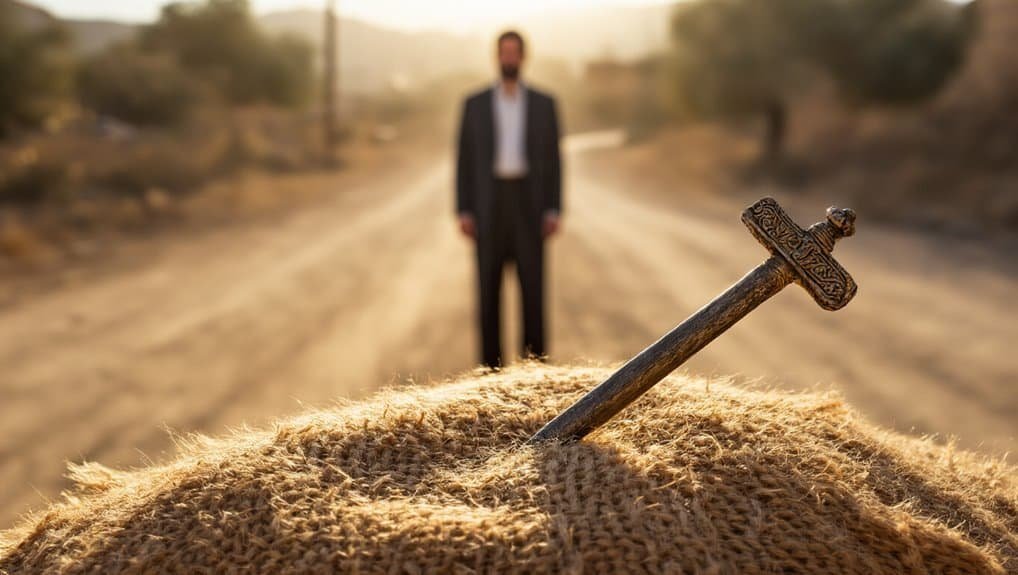
When you examine the synoptic accounts of Jesus’s encounter with the rich young ruler, you’re witnessing a pivotal moment that occurs during Christ’s final journey to Jerusalem, likely in Perea according to the Markan narrative sequence (Mark 10:17-31; Matthew 19:16-30; Luke 18:18-30).
This first century dialogue unfolds when a wealthy man approaches Jesus, addressing him as “Good Teacher” and inquiring about eternal life. You’ll notice Jesus redirects the man’s attention to God’s goodness before citing the Decalogue’s second table. The ruler’s claim of complete observance since youth reflects the rabbinic milieu where Torah adherence defined righteousness.
Christ’s penetrating response—”sell everything”—exposes the man’s true allegiance. When he departs grieved, you’re seeing Jesus reveal how wealth becomes an insurmountable obstacle to kingdom entrance. The disciples’ astonishment indicates they’ve absorbed their culture’s equation of prosperity with divine blessing, making Jesus’s subsequent hyperbolic statement about camels and needle eyes particularly jarring.
Understanding the Camel and Needle Metaphor in Ancient Jewish Culture
You’ll recognize Jesus’ camel-and-needle metaphor as a classic example of rabbinic hyperbole, a teaching device where Jewish rabbis employed impossible scenarios to emphasize spiritual truths.
In first-century Palestine, this rhetorical technique wasn’t meant for literal interpretation but served to shock listeners into grasping the radical nature of God’s kingdom economics.
The Talmud records similar expressions like “an elephant through a needle’s eye,” confirming that Jesus drew from an established tradition of using absurd impossibilities to communicate that wealth’s grip on the human heart requires divine intervention to break.
Ancient Jewish Hyperbole Traditions
Throughout ancient Jewish literature, rabbis employed striking hyperboles to drive home moral teachings, and Jesus’s camel-through-needle metaphor fits squarely within this pedagogical tradition. You’ll find similar rabbinic exaggeration in the Talmud, where teachers spoke of “an elephant passing through a needle’s eye” to illustrate impossibility. This hyperbolic speech wasn’t meant for literal interpretation but served as a rhetorical device to shock listeners into spiritual awareness.
When you examine first-century Jewish discourse, you’ll discover that extreme comparisons functioned as standard teaching tools. Rabbis regularly used absurd imagery—mountains uprooting themselves, seas splitting like garments—to emphasize divine power versus human limitation. Jesus’s audience would’ve immediately recognized this linguistic pattern, understanding that he wasn’t describing a literal scenario but highlighting the radical impossibility of self-achieved salvation.
First Century Cultural Context
As merchants led their camels through Jerusalem’s narrow streets, first-century Palestinians witnessed daily the stark contrast between these massive beasts of burden and the tiny bronze needles used for mending garments.
You’d have seen wealthy traders navigating Roman roadways with camel caravans loaded with precious cargo, while poor women sat nearby repairing first century textiles with needles barely visible to the eye.
This visual juxtaposition wasn’t lost on Jesus’s audience. They understood the absurdity immediately—a camel’s bulk couldn’t possibly compress through a needle’s eye.
The metaphor’s power lay in its everyday familiarity. You’re dealing with common objects that symbolized opposing extremes: camels represented commercial wealth and trading power, while needles embodied domestic simplicity and modest labor.
Common Misinterpretations About the Jerusalem Gate Theory
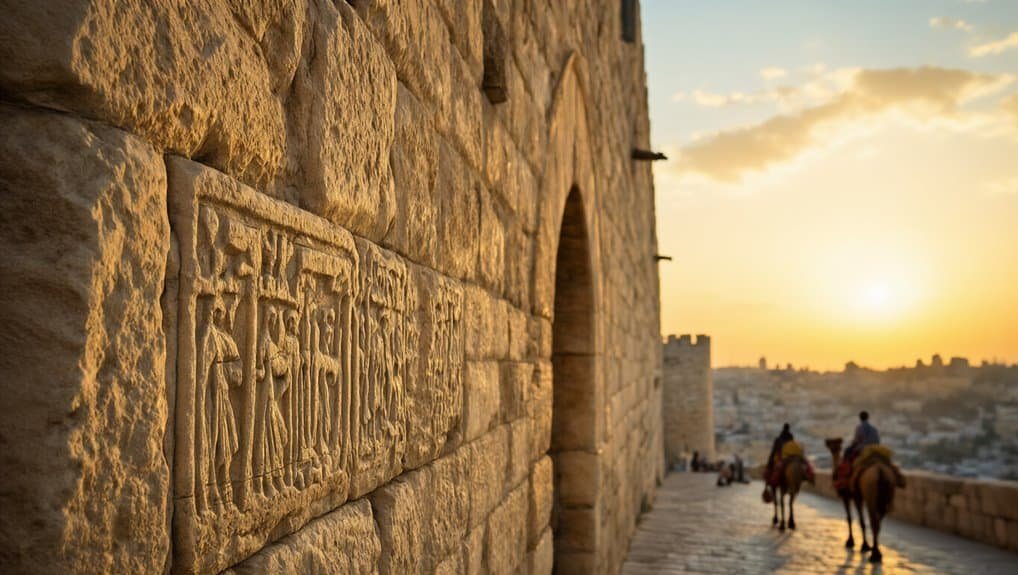
While the Jerusalem gate theory has gained widespread acceptance in many Christian circles, it’s built on a foundation of historical inaccuracy that deserves careful scrutiny. You’ve likely heard preachers explain that the “eye of a needle” referred to a small Jerusalem gate where camels had to kneel and unload their goods to pass through. This needle gate interpretation, however, lacks any archaeological or historical evidence from Jesus’s time.
The gate myth first appeared in medieval commentaries, centuries after Christ’s teaching. No ancient Jewish or Greek sources mention such a gate existing in first-century Jerusalem. You’re dealing with an anachronistic explanation that softens Jesus’s stark metaphor about wealth and salvation. The Greek word used is “rhaphis,” meaning a literal sewing needle, not “pyle” (gate).
When you examine the disciples’ astonished response—”Who then can be saved?”—it’s clear they understood Jesus’s impossibility statement, not a merely difficult task.
Why Jesus Connected Wealth With Spiritual Obstacles
When you examine Jesus’ teaching patterns throughout the Gospels, you’ll notice He consistently identifies wealth as a spiritual barrier because material security naturally undermines your need to depend on God’s provision.
The Greek term “mammon” that Jesus uses reveals wealth’s personified nature as a competing master—you can’t serve both because money demands the same exclusive devotion that God requires.
Your accumulated resources create an illusion of self-sufficiency that directly opposes the kingdom’s foundational principle of absolute dependence on divine grace.
Material Security Blocks Faith
Throughout the Gospels, Jesus repeatedly identifies wealth as a fundamental spiritual obstacle because material security creates a false sense of self-sufficiency that directly opposes the radical dependence faith requires.
When you possess abundant resources, you’re tempted to trust your bank account rather than God’s provision.
This material attachment becomes financial idolatry—wealth transforms from a tool into a master.
The Greek term “mammon” that Jesus uses isn’t merely “money” but encompasses an entire system of earthly security.
You can’t serve both God and mammon because each demands exclusive allegiance.
Wealth doesn’t just distract; it actively competes for your soul’s devotion.
The rich young ruler‘s sorrow reveals this truth: he couldn’t release his possessions because they’d already possessed him.
Material security promises what only faith delivers—but it’s a counterfeit promise.
Money Divides Heart’s Loyalty
Division emerges at wealth’s core—not merely between rich and poor, but within the human heart itself.
Jesus’s teaching exposes how mammon functions as a rival deity, demanding the allegiance you’re meant to give God alone. The Aramaic term “mammon” wasn’t simply currency—it personified wealth as a spiritual force competing for worship.
You can’t serve two masters because wealth attachment restructures your soul’s orientation. Money idols don’t coexist peacefully with divine loyalty; they actively subvert it.
First-century Palestinian culture understood this tension—wealthy Sadducees often compromised Torah principles for Roman economic advantages. Christ’s needle metaphor reveals how riches create competing allegiances, splitting your devotion between earthly security and heavenly trust. When possessions become your functional savior, they’ve already displaced God’s rightful position.
The Disciples’ Shocked Response and What It Reveals
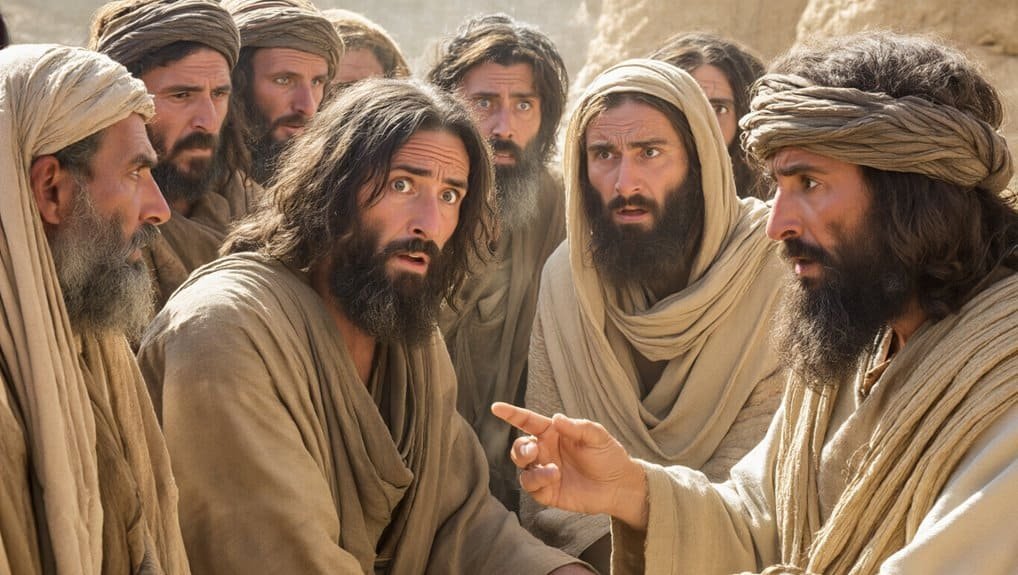
Though Jesus often challenged conventional wisdom, his pronouncement about the rich entering God’s kingdom struck the disciples with unprecedented force, prompting their astonished question: “Who then can be saved?” (Matthew 19:25).
Jesus’ pronouncement about wealth and salvation struck the disciples with unprecedented force, shattering their theological framework.
You’ll notice their disciples’ astonishment reveals deep cultural surprise—they’d internalized the prevailing Jewish belief that wealth signified God’s blessing and favor. In first-century Palestine, prosperity wasn’t merely material success; it represented divine approval and righteousness.
The Greek term “ἐξεπλήσσοντο” (exeplēssonto) indicates they were “exceedingly amazed,” literally struck out of their senses.
You’re witnessing their entire theological framework crumbling. If the wealthy—those seemingly blessed by God—can’t enter the kingdom, what hope exists for ordinary people? Their response exposes how thoroughly they’d absorbed the deuteronomic principle linking obedience with material blessing.
Jesus hasn’t just corrected a minor misunderstanding; he’s overturned their fundamental assumptions about salvation, merit, and divine favor.
How Material Possessions Can Become Idols
When you accumulate wealth, you’re tempted to replace your dependence on God with trust in financial security—a phenomenon the ancient Near Eastern cultures recognized as they witnessed merchants worshipping mammon alongside Yahweh.
Your possessions don’t merely reflect your status; they’ve become the foundation of your identity, transforming from tools into masters that demand your allegiance.
The Greek word “plousios” (wealthy) in Jesus’s teaching carries connotations of self-sufficiency, revealing how material abundance creates a false sovereignty that directly competes with God’s rightful place in your heart.
Wealth Replaces God
Many believers unknowingly allow material wealth to occupy the throne of their hearts, transforming possessions from tools into idols that compete with God’s rightful place. This spiritual displacement occurs when you prioritize financial security over divine providence. The Greek term “mammon” (μαμωνᾶς) that Jesus employed wasn’t merely “money” but personified idol wealth—a rival deity demanding allegiance.
You’ll notice first-century Jewish texts warned against wealth’s deceptive power to usurp God’s sovereignty. When riches become your primary source of identity, comfort, and hope, they’ve effectively replaced the Creator. You can’t serve two masters because wealth demands exclusive devotion, consuming your thoughts, directing your decisions, and ultimately reshaping your worship. This substitution happens gradually—you don’t abandon God overtly but incrementally transfer your trust from eternal promises to temporal securities.
Security Through Money
The pursuit of financial security reveals itself most clearly when you examine your response to economic uncertainty. When market volatility strikes, where do you turn first—prayer or your portfolio? The Greek term πλοῦτος (ploutos) encompasses not merely wealth but the false confidence it generates.
You’ve developed a security mindset that treats money as your primary shield against life’s uncertainties. This financial dependence mirrors Israel’s trust in foreign alliances rather than Yahweh’s provision. The Aramaic mammon, meaning “that in which one trusts,” exposes money’s transformation from tool to idol.
Consider how you’d react if your savings vanished tomorrow. That emotional response reveals whether you’ve anchored your peace in Christ’s sufficiency or material accumulation. The wealthy young ruler couldn’t release his possessions because they’d become his functional savior.
Identity in Possessions
Your possessions’ grip on your identity reveals itself through the ancient Hebrew word קִנְיָן (qinyan), meaning both “possession” and “creation”—suggesting that what you acquire becomes part of who you are. This linguistic connection exposes why Jesus confronted the rich young ruler‘s attachment to wealth. When identity possessions define your worth, they’ve crossed from tools to idols.
You’ll notice first-century Palestinian culture measured honor through landholdings and inherited wealth, establishing rigid self ownership boundaries. The wealthy weren’t merely affluent—they derived their social existence from material accumulation. Jesus’s needle metaphor dismantles this framework, demanding you separate who you’re from what you own. His teaching doesn’t condemn ownership itself but challenges the fusion of possessions with personhood that prevents kingdom entry.
The Meaning of “With God All Things Are Possible”
Divine possibility transcends human limitation in Christ’s profound declaration following the camel and needle metaphor. When Jesus states “with God all things are possible” (Matthew 19:26), He’s not offering cheap comfort but revealing salvation’s true source. You can’t engineer your spiritual deliverance through moral achievement or religious performance.
The Greek word “dynata” (possible) paired with “para Theō” (with God) establishes divine agency as salvation’s foundation. You’re witnessing Jesus redirect His disciples from human effort to divine grace. This isn’t about God helping you squeeze through narrow spaces—it’s about Him creating new pathways entirely.
Your faith perseverance doesn’t earn this divine possibility; it receives it. The rich young ruler‘s departure illustrates humanity’s inability to self-save, while Peter’s question “who then can be saved?” acknowledges this impossibility. Christ’s answer demolishes works-based righteousness. You’re called to recognize that what’s impossible through human strength becomes achievable through God’s sovereign intervention and transforming power.
Biblical Examples of Wealthy People Who Found Salvation
Scripture’s testimony presents numerous wealth-holders who experienced genuine conversion despite their material abundance. You’ll find Zacchaeus exemplifies radical transformation—this tax collector’s encounter with Christ prompted him to restore fourfold what he’d defrauded and give half his possessions to the poor (Luke 19:8). His response demonstrates repentance’s authentic fruit.
Consider Joseph of Arimathea, a wealthy Sanhedrin member who risked everything to provide Jesus’s tomb (Matthew 27:57-60). You’re witnessing courage that transcended social position.
Similarly, Lydia, the purple merchant from Thyatira, opened her household to Paul’s ministry after conversion (Acts 16:14-15). These transformed magnates didn’t abandon wealth but stewarded it for Kingdom purposes.
The Ethiopian eunuch, treasurer to Queen Candace, received Philip’s gospel teaching while traveling in his chariot (Acts 8:27-39). These rich philanthropists prove wealth doesn’t automatically disqualify anyone from salvation—it’s one’s heart posture toward possessions that determines spiritual receptivity.
Practical Applications for Modern Christians and Money
Stewarding financial resources in today’s economy demands you apply Christ’s needle-eye teaching through concrete practices that reflect Kingdom priorities. You’re called to examine your attachment to wealth through the lens of Jesus’s radical statement, recognizing that accumulation isn’t inherently evil but idolatry is spiritually fatal.
Your stewardship practices must transcend mere tithing. You’ll need to cultivate what early church fathers termed “detachment”—holding possessions loosely while using them purposefully for God’s glory. This means you’re evaluating every financial decision against eternal values, not cultural expectations.
Today’s generosity challenges require you to move beyond comfortable giving toward sacrificial participation in God’s work. You can’t simply manage money; you must deploy it missionally. Consider how first-century believers sold properties to meet community needs—this radical redistribution exemplified the needle’s eye passage practically.
You’re tasked with translating this apostolic model into contemporary contexts, whether through supporting ministry, alleviating poverty, or investing in Kingdom enterprises that prioritize spiritual over financial returns.
The Radical Call to Surrender Everything for the Kingdom
When Jesus demanded the rich young ruler sell everything and follow Him, He wasn’t proposing an optional spiritual discipline but establishing the non-negotiable terms of discipleship. The Greek verb “akolouthei” (follow) appears as an imperative, commanding immediate action. You’re confronted with Christ’s uncompromising standard: total surrender of material attachments that rival God’s supremacy.
This encounter exposes the heart’s divided loyalties. The ruler’s wealth wasn’t merely possessions—it represented his identity, security, and social standing. Jesus diagnosed his spiritual condition precisely: treasure on earth had become his functional savior. You can’t serve two masters.
The call to radical generosity flows from recognizing the Kingdom’s infinite worth. Like the merchant who sold everything for one pearl, you’re invited to calculate correctly: temporary wealth versus eternal treasure. Christ doesn’t negotiate partial commitments. He demands your whole life, knowing that only complete surrender liberates you from mammon’s tyranny into Kingdom abundance.
Frequently Asked Questions
Which Gospel Books Contain the Eye of the Needle Verse?
You’ll find the eye of the needle verse in three synoptic gospels: Matthew 19:24, Mark 10:25, and Luke 18:25. John doesn’t include this pericope.
Each synoptic account preserves Jesus’s hyperbolic metaphor using the Greek word κάμηλος (kamelos) for camel and ῥαφίς or τρῆμα for needle’s eye. Matthew and Mark place it after the rich young ruler narrative, while Luke’s parallel maintains identical theological thrust with slight verbal variations in the Greek manuscript tradition.
Did Jesus Literally Mean People Should Give Away All Possessions?
You’ll find Jesus didn’t universally command wealth abandonment, but called specific individuals to radical discipleship through complete divestment.
The Greek term “teleios” (perfect/complete) in Matthew 19:21 suggests this was particular guidance for the rich young ruler‘s spiritual condition.
While Jesus emphasized charitable giving throughout his ministry, he also praised Zacchaeus for giving half his possessions.
You’re seeing contextual pastoral counsel, not blanket economic mandate for all believers.
What Is the Exact Greek Word Used for “Needle” in This Passage?
You’ll find the Greek word “rhaphís” (ῥαφίς) used for “needle” in Matthew 19:24 and Mark 10:25, referring to a literal sewing needle. Luke 18:25 uses “belónē” (βελόνη), meaning a surgical needle. Neither Gospel employs “kéryx” (herald/preacher) in this passage.
The rhaphís specifically denotes a common household sewing implement, dismissing later theories about city gates. You’re seeing Jesus deliberately choosing everyday objects to create his striking metaphor about wealth and salvation.
How Do Different Christian Denominations Interpret This Teaching Today?
You’ll find mainline Protestants embrace a liberal interpretation emphasizing social justice and wealth redistribution.
Catholic teaching maintains sacramental emphasis on detachment from riches while affirming legitimate ownership.
Prosperity gospel churches face prosperity critique for softening Christ’s radical demands.
You’ll notice evangelical caution against both extremes—neither mandating poverty nor blessing greed.
Eastern Orthodox traditions stress theosis, viewing wealth as potential obstacle to deification.
Each denomination’s hermeneutical framework shapes contemporary application.
Are There Similar Teachings About Wealth in Other Religions?
You’ll find striking charitable parallels across major world religions. Buddhism’s Middle Way warns against attachment to wealth, while Islam mandates zakat as obligatory almsgiving. Hindu dharma prescribes dana (charitable giving), and Judaism emphasizes tzedakah as righteous obligation.
These renunciation parallels demonstrate universal recognition that material accumulation impedes spiritual progress. Each tradition’s sacred texts articulate wealth’s corrupting potential through distinct theological frameworks, yet they’re unified in advocating detachment from worldly possessions.
Conclusion
You’ve discovered that Jesus’ needle’s eye metaphor isn’t about threading camels through gates but confronting wealth’s spiritual dangers. The Greek term “kamelos” definitively means camel, not rope, emphasizing the hyperbolic impossibility. Yet Christ’s promise that “with God all things are possible” transforms this teaching from despair to hope. You’re called not to poverty but radical surrender—where possessions don’t possess you. The kingdom demands everything, but God’s grace makes the impossible journey possible.







No Comments