

15 Apr Why 3000 Were Baptized After Peters Sermon
You feel the urgency in Peter’s bold proclamation of Christ’s death, resurrection, and forgiveness, and the Holy Spirit’s fire lights conviction in the crowd. The Spirit illuminates Scripture, softens fear, and empowers people to step into a public, transformative act of faith. Water immersion becomes a visible declaration of new identity, cleansing, and belonging for Jews, men, women, and children alike. If you keep exploring, you’ll discover what these baptisms reveal about the early Christian movement.
Why Did Peter’s Sermon Trigger the 3,000 Baptisms?
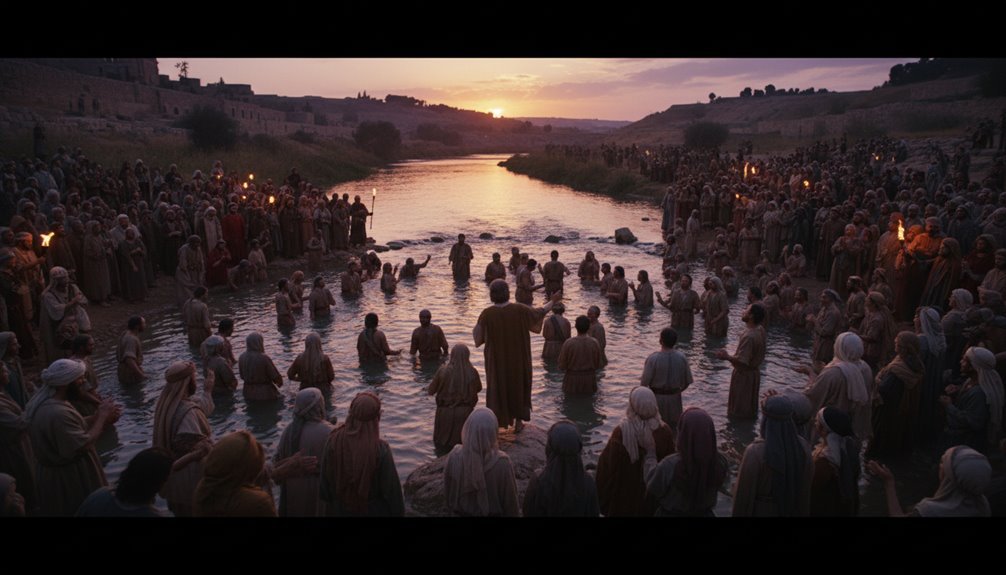
Why did Peter’s sermon spark the flood of 3,000 baptisms? You hear his voice echoing through the crowded shore, each word cutting through doubt like a blade. He recounts the crucifixion, the resurrection, and the promise of forgiveness, linking the ancient prophecy to the present moment. His urgency feels personal; you sense that salvation isn’t a distant myth but an immediate invitation. He calls for repentance, urging you to turn away from past sins and embrace a new life. The crowd, weary and hungry for hope, feels the weight of his conviction. As he declares the name of Jesus, a collective gasp rises, then a wave of agreement. You notice the water at the Jordan, the simple act of immersion becoming a public declaration of faith. The crowd’s response swells, and you witness the birth of a community bound by shared belief.
How Did the Holy Spirit Empower Those Baptisms?
How did the Holy Spirit actually move those new believers? You felt a sudden surge of conviction as the crowd listened, a palpable stirring that turned curiosity into commitment. The Spirit illuminated Scripture, making Peter’s words crackle with relevance, and opened hearts to the promise of forgiveness. You sensed an inner fire that softened fear, allowing you to step forward without hesitation. That divine empowerment forged a shared sense of belonging, linking each individual to the emerging community of faith.
As you were baptized, the Spirit’s presence confirmed your new identity, sealing you with a promise of ongoing guidance. You left the water not merely cleansed but equipped, confident that the same power that drew you in would sustain your walk, inspire growth, and empower you to proclaim the gospel boldly.
Who Were the 3,000 People Baptized on the Day?
Who exactly made up the crowd of 3,000 baptized that day? You’ll find they were mostly Jews from Jerusalem and surrounding regions, drawn by Peter’s bold proclamation that Jesus was the Messiah. Many had heard the news of Jesus’ resurrection and were eager for a tangible sign of their new faith. Among them were men, women, and children—families who gathered at the lake of Bethesda, listening to Peter’s message of repentance and forgiveness.
Some were lifelong believers who’d followed Jesus during his ministry, while others were recent converts who responded to the Spirit’s stirring. Their common thread was a desire to be cleansed of sin and to join the nascent community of believers. By stepping into the water, they publicly identified with Christ’s death and resurrection, marking the beginning of a shared identity that would shape early Christianity.
What Do the 3,000 Baptisms Reveal About Early Christianity?
What does the mass baptism of 3,000 tell you about the shape of early Christianity? It shows you that the movement was already organized, charismatic, and eager to expand. You see a community that valued public confession, ritual initiation, and communal identity. The sheer number signals that Peter’s sermon resonated beyond a handful of listeners; it sparked a collective response, suggesting a shared urgency for belonging and salvation. You also notice that the baptism was performed by a single apostle, highlighting a centralized authority that could mobilize crowds. This event reveals how early Christians blended Jewish purification rites with a new gospel proclamation, creating a distinctive practice that set them apart. As you reflect, you realize the 3,000 baptisms illustrate a rapid, organized spread of faith, a willingness to embrace new identity, and a foundation for the church’s future growth.
Frequently Asked Questions
What Historical Sources Corroborate the 3,000 Baptism Figure?
You’ll find the 3,000 baptism count mainly in Acts 2:41, where Luke records the crowd’s response. Early church fathers like Irenaeus (Against Heresies 5.1.2) and Eusebius (Ecclesiastical History 2.12) repeat the number, treating it as a historical tradition. Some modern scholars note that the figure likely serves a theological purpose, yet these sources collectively preserve the early Christian claim.
Did Any Women or Children Belong to the 3,000 Baptized?
You can’t say for sure, but the text doesn’t separate the groups.
Acts 2:41 says “the few who believed” were baptized, and the narrative mentions “men, women, and children” elsewhere, yet it never breaks down the 3,000 count.
How Long Did the Baptism Ceremony Last on That Day?
You likely spent only a few minutes on each person’s immersion, because the crowd moved quickly. Peter’s brief preaching and the subsequent water rite weren’t a prolonged liturgy; they were a rapid, communal event. You’d have seen people step into the water, be lifted, and emerge within seconds, so the whole ceremony probably wrapped up in under an hour, perhaps even just thirty minutes total.
What Was the Geographic Origin of the 3,000 Participants?
You’re looking at a crowd drawn mainly from the surrounding Judean countryside, especially the villages near Jerusalem and the coastal plain of Ailee. Most of the 3,000 were Gentile converts from regions like Caesarea, Lydda, and the Decapolis, while a smaller number were Jews from the city itself. Their common thread was curiosity about Peter’s message, prompting them to gather at the house of Cornelius for baptism.
Were Any Non‑Jewish Individuals Included in the 3,000 Baptisms?
You’ll find that the 3,000 baptisms were almost entirely of Jewish believers; the narrative emphasizes that those who heard Peter’s sermon were “those who believed” from the crowd of Jews in Jerusalem.
While the text doesn’t explicitly mention Gentile converts among the 3,000, the broader Acts context later shows Gentiles joining the movement, but this specific event focuses on Jewish participants.
Conclusion
You’ve seen how Peter’s bold sermon sparked a wave of faith, how the Holy Spirit poured out power, and who the 3,000 newly baptized were. Their response shows that early Christianity thrived on clear proclamation, divine empowerment, and a community eager for transformation. This pivotal moment reveals the movement’s capacity to draw crowds, ignite belief, and lay a foundation that still reverberates today.









No Comments