

13 Apr 5 Best Verses About Gods Eternal Love
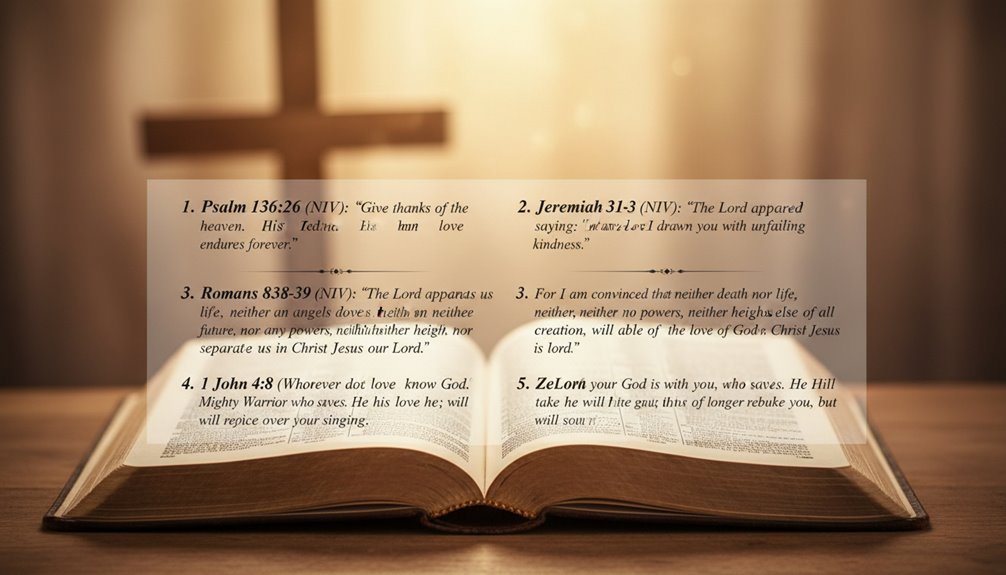
You’ll find God’s eternal love in John 3:16’sHe gave His Son for the world), Romans 8:38‑39 (nothing can separate us from His love), Psalm 136 (every verse ends, “His love endures forever”), 1 John 4:7‑21 (we’re called to love one another), and Jeremiah 31:3 (He loves us with an everlasting love). These passages show His unchanging, sacrificial, and assuring affection, and the next verses will reveal how they shape daily hope.
What the Bible Says About God’s Eternal Love
What does the Bible reveal about God’s eternal love? You’ll find that Scripture paints love’s affection as unending, unchanging, and boundless. In Psalm 136 each verse ends with “His love endures forever,” underscoring a love that never fades. Jeremiah 31:3 declares, “I have loved you with an everlasting love,” emphasizing that divine love precedes and outlasts every human era. Romans 8:38‑39 assures you nothing can separate you from this love, not death, life, or any circumstance.
The New Testament repeats the theme: 1 John 4:8 states, “God is love,” making love an essential attribute, not a mere action. These passages converge on a single truth: God’s love isn’t a fleeting feeling but an eternal, immutable commitment that embraces you across time and circumstance. Recognizing this steadiness transforms how you trust, hope, and live daily.
John 3:16 – Bible Verse About God’s Love (Grace)
Ever wondered how a single verse can capture God’s boundless grace? John 3:16 tells you that God loved the world so deeply He gave His only Son, that anyone who believes won’t perish but will have eternal life. You feel that love as a promise, not a vague idea. It’s a concrete act—Jesus’ sacrifice—showing that divine love reaches beyond borders, cultures, and sins. When you place your trust in Him, you join a lineage of believers who experience forgiveness and hope. The verse also reminds you that God’s love isn’t limited to a select few; it’s universal, inviting every heart to respond. As you meditate on these words, let them shape your identity: loved, redeemed, and destined for everlasting communion with God. This simple sentence packs a profound theology of grace, urging you to live confidently in the light of God’s unending love.
Romans 8:38‑39 – Bible Verse About God’s Love (Assurance)
Can anything shake the certainty that God’s love will never let you go? Romans 8:38‑39 tells you that no power, death, or circumstance can separate you from the love of Christ. The passage lists every possible barrier—life, death, angels, rulers, present, future, height, depth, and any other thing created. Yet it ends with a bold declaration: nothing can sever that bond. When you feel overwhelmed, this verse becomes an anchor, reminding you that your worth isn’t tied to achievements or approval. It assures you that divine love is unconditional and immutable, persisting beyond every trial. By internalizing this promise, you gain confidence to face uncertainty, knowing that the Creator’s affection remains steadfast. Let the assurance of Romans 8:38‑39 transform doubt into peace, and let it shape how you walk through each day, secure in the unbreakable love that holds you.
Psalm 136:1‑26 – Bible Verse About God’s Love (Thankful Prayer)
Romans 8:38‑39 reminds you that nothing can separate you from Christ’s love, and that confidence naturally leads to gratitude. In Psalm 136 you’re invited into a rhythmic thanksgiving that echoes “His love endures forever.” Each verse repeats that refrain, anchoring you in the constancy of God’s covenant. You’ll notice the psalmist recounts creation, deliverance, and provision—sun, moon, stars, and the Red Sea—each time declaring God’s steadfast love. This pattern trains your heart to recognize divine faithfulness in everyday moments, from the food on your table to the victories you’ve won. As you pray this psalm, you’re not just reciting words; you’re affirming a reality that God’s love never wanes. Let the repeated phrase settle in your spirit, reminding you that every breath, every sunrise, and every rescue is a testimony to a love that endures eternally.
1 John 4:7‑21 – Bible Verse About God’s Love (Living Out)
How does the Samaritan woman’s encounter with Jesus reveal love in action? You see her at the well, weary from work, and Jesus greets her without judgment. He offers living water, a metaphor for spiritual fulfillment that transcends physical thirst. By breaking cultural barriers—Jew and Samaritan, man and woman—He demonstrates love that reaches beyond social norms. Your reading of John 4:7‑21 shows that love isn’t passive; it initiates conversation, listens, and meets deeper needs. Jesus’s question, “Will you give me a drink?” invites reciprocity, turning a simple request into a profound exchange. When she recognizes Him as the Messiah, her testimony spreads, illustrating how lived love becomes evangelistic. This passage teaches you that authentic love involves humility, service, and the courage to cross boundaries. Embrace this model: approach others with genuine care, offer spiritual sustenance, and let transformed lives testify to divine love.
Frequently Asked Questions
How Can I Memorize These Verses Efficiently?
You’ll memorize them faster if you break each verse into short phrases, repeat them aloud, and pair them with a visual cue or melody.
Write the lines on flashcards, test yourself daily, and shuffle the order to avoid rote sequencing.
Use spaced‑repetition apps, recite before bed, and connect each verse to a personal story or emotion.
Consistent, active recall builds lasting memory.
Do These Verses Apply to Non‑Christian Beliefs?
You can see those verses as universal expressions of love, but they’re rooted in Christian theology, so they specifically describe God’s covenant with believers. If you hold non‑Christian faiths, you might still appreciate the moral ideas, yet the divine identity and promises differ.
You can extract the broader principle of unconditional love, but the exact scriptural claims won’t align with other religious frameworks.
What Historical Context Influenced These Passages?
You’re looking at texts shaped by the Roman Empire’s dominance, early Christian persecution, and Jewish diaspora experiences. The writers responded to oppression, hoping for divine reassurance, and to Hellenistic philosophy, which stressed ideal forms and eternal truths. Their language reflects a blend of Hebrew prophetic tradition and Greco‑Roman rhetorical style, aiming to comfort believers facing social marginalization and cultural upheaval. This backdrop fuels the emphasis on God’s unending, all‑encompassing love.
Can These Verses Be Used in Therapeutic Settings?
Yes, you can incorporate those verses into therapy. When you share them, you’re offering clients a source of comfort and meaning that can reduce anxiety and foster hope. Use them as prompts for reflection, grounding exercises, or gratitude journaling. Make sure you respect each person’s beliefs, obtain consent, and integrate the verses alongside evidence‑based techniques so they support, rather than replace, professional treatment.
How Do Different Denominations Interpret God’s Eternal Love?
You’ll find each tradition frames God’s eternal love through its own theological lens.
Catholics emphasize sacramental grace, seeing love as a covenant fulfilled in Christ and the Church.
Protestants stress personal relationship, interpreting love as a promise that assures salvation.
Evangelicals often highlight missionary urgency, viewing love as a call to evangelize.
Orthodox Christians stress theosis, describing love as participation in divine life.
Each perspective shapes worship, doctrine, and daily practice uniquely.
Conclusion
You’ve seen how Scripture paints God’s love as endless, unshakable, and active in every moment of your life. From the promise of eternal salvation in John 3:16 to the unwavering assurance of Romans 8:38‑39, the grateful chorus of Psalm 136, and the call to love one another in 1 John 4:7‑21, each verse invites you to trust, rejoice, and embody that divine love daily. Let these truths shape your heart and guide your walk.










No Comments