


22 Aug Discover the Beauty of Historical Musical Instruments Through Time
You’ll find that musical instruments stretch back over 40,000 years, beginning with bone flutes crafted from bird bones and mammoth ivory. Early civilizations developed sophisticated wind, string, and percussion instruments – from Egyptian harps and Greek kitharas to Roman military horns. Each culture’s innovations built upon previous designs, incorporating indigenous materials and acoustic principles. The evolution of these instruments reveals intricate technological achievements that transformed human expression through the ages.
Table of Contents
Key Takeaways
- Ancient bone flutes, dating back 40,000 years, represent humanity’s earliest known musical instruments, crafted from bird bones and mammoth ivory.
- Egyptian harps played crucial roles in religious ceremonies from 3000 BCE, featuring both bow and angular configurations.
- Basic percussion instruments emerged over 35,000 years ago, serving both ceremonial and practical purposes across ancient civilizations.
- Indigenous cultures developed sophisticated instruments like water drums and talking drums that demonstrated advanced acoustic understanding.
- The piano’s invention in 1700 by Bartolomeo Cristofori revolutionized musical expression with its innovative hammer mechanism.
Ancient Bone Flutes and Early Wind Instruments
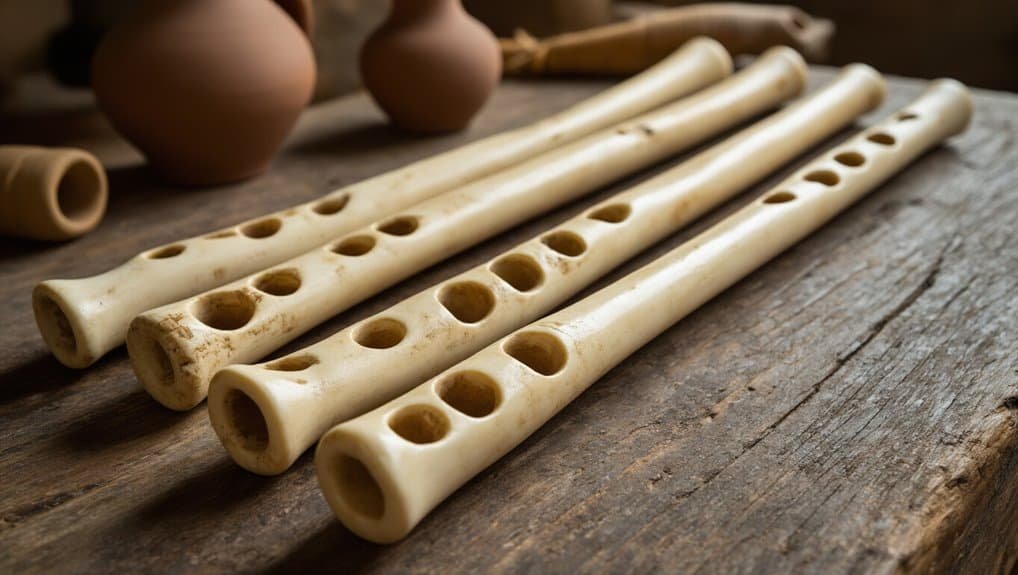
Several ancient bone flutes, dating back over 40,000 years, represent humanity’s earliest known musical instruments.
You’ll find these prehistoric wind instruments crafted from bird bones and mammoth ivory, particularly in archaeological sites across Europe. The most notable discoveries include the Hohle Fels flute from Germany and the Divje Babe flute from Slovenia.
When you examine bone flute techniques from these periods, you’ll notice sophisticated craftsmanship.
Craftspeople carefully hollowed out bones, created precisely spaced finger holes, and often added notched ends for mouthpieces. They’d typically position the holes to produce specific musical scales, suggesting an advanced understanding of acoustics.
You can still observe the influence of these early designs in modern wind instruments.
The basic principles of sound production – blowing across a sharp edge to create vibrating air columns – haven’t changed since Paleolithic times, though today’s instruments feature more complex mechanisms and materials.
Egyptian Harps and Sacred Instruments
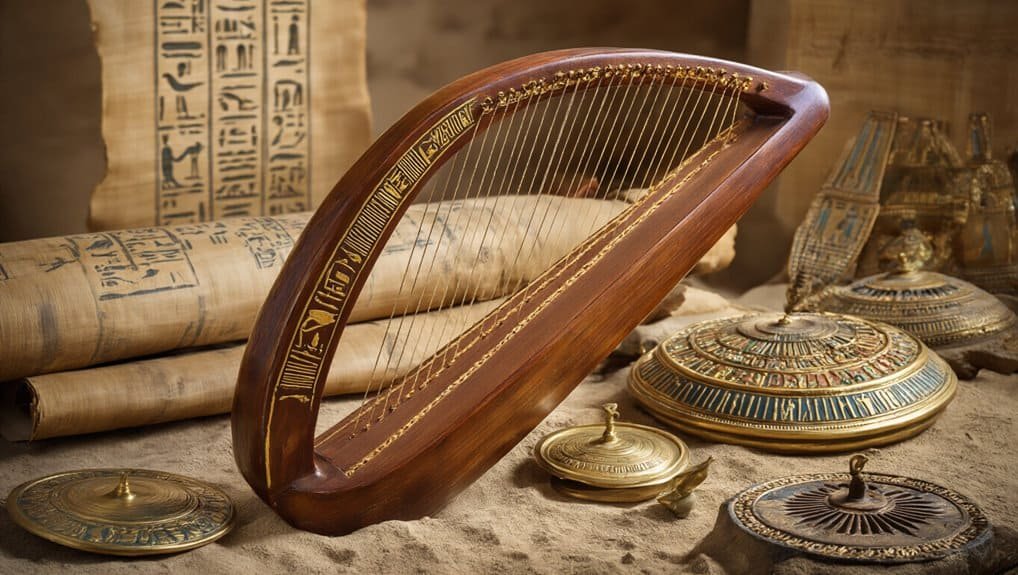
You’ll find Ancient Egyptian harps came in two primary configurations: the bow harp with its curved neck and the angular harp featuring a more perpendicular design, both crafted from wood and adorned with intricate hieroglyphics.
As a vital component of religious ceremonies from 3000 BCE onward, these harps accompanied hymns to deities like Hathor and Isis, with their resonant tones believed to bridge the mortal and divine realms.
Royal court musicians, particularly during the New Kingdom period (1550-1070 BCE), achieved elevated social status as professional harpists, performing complex compositions that you can still see depicted in tomb paintings and temple reliefs.
Ancient Egyptian Harp Designs
Ancient Egyptian harps represented some of the earliest and most sophisticated string instruments in human history, dating back to approximately 2500 BCE.
You’ll find these harps distinguished by their gracefully curved necks and resonating bodies, showcasing remarkable ancient craftsmanship in their construction.
When you examine Egyptian tomb paintings, you’ll notice two primary harp designs: the bow harp and the angular harp.
The bow harp featured a curved sound box that extended into an elegant arch, while the angular harp displayed a more perpendicular junction between its neck and sound chamber.
Both types carried symbolic significance, with their decorative elements often incorporating divine motifs like lotus flowers and pharaonic symbols.
The materials used typically included indigenous woods, particularly sycomore fig and tamarisk, with strings crafted from dried animal gut.
Religious Ceremonies and Music
While religious ceremonies dominated Egyptian cultural life, musical instruments, particularly harps, played a central role in temple rituals and sacred processions. You’ll find that priests used these instruments to accompany chanting traditions that honored deities like Osiris and Isis. The harps’ distinct tones enhanced sacred melodies, creating an atmosphere of divine connection.
In temple settings, you’d have witnessed musicians performing on angular harps during offerings to the gods, while arched harps were preferred for processional ceremonies. The instruments’ resonance helped maintain precise rhythmic patterns that guided worshippers through complex ritual sequences.
These musical practices weren’t merely entertainment; they served as essential bridges between the earthly and divine realms, with specific melodies believed to please particular deities and facilitate spiritual transformation.
Royal Court Harp Players
Royal harpists held prestigious positions in Egyptian courts, serving as both musicians and spiritual intermediaries between pharaohs and the gods.
You’ll find that these elite performers mastered intricate bow-shaped harps, which evolved from simple hunting bows into sophisticated instruments with up to 12 strings.
In the royal court, harp traditions dictated specific playing techniques and ritualistic performances.
You’d see harpists performing during ceremonies, banquets, and religious festivals, often accompanying vocals with complex melodic patterns.
Their instruments featured ornate decorations, including carved heads of Hathor, the goddess of music.
These court musicians passed down their knowledge through careful apprenticeship systems, ensuring the preservation of sacred melodies and playing techniques across generations.
Archaeological evidence shows that some harpists achieved such high status that they received elaborate tombs near their pharaohs.
Greek and Roman Musical Heritage
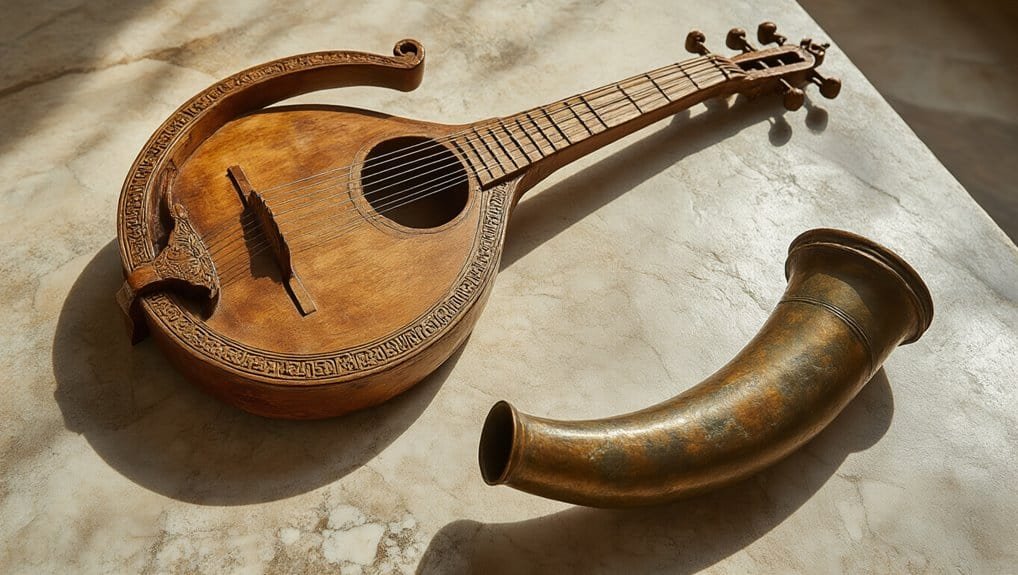
You’ll discover that ancient Greek wind instruments, including the double-reed aulos and pan pipes, laid the foundation for many modern woodwinds through their sophisticated acoustic designs.
The Romans expanded upon this musical legacy with their military horns, particularly the cornu and tuba, which served crucial battlefield signaling functions while influencing medieval brass instrument development.
Throughout the Mediterranean region, you can trace the evolution of string instruments from the simple lyra to the more complex kithara, which featured up to eleven strings and established tuning systems that would influence European musical development for centuries.
Ancient Greek Wind Instruments
Ancient Greek civilization left an indelible mark on musical history through its diverse array of wind instruments, which shaped both ceremonial and secular music from 800 BCE to 146 BCE.
You’ll find that the double-reed aulos, a pair of pipes played simultaneously, dominated religious ceremonies and theatrical performances. Its distinctive sound required skilled breath control and finger dexterity during aulos performance.
While the lyre construction received significant attention in Greek culture, wind instruments like the syrinx (pan pipes) and salpinx (bronze trumpet) played crucial roles in both artistic and military settings.
The hydraulis, an early pipe organ, represented Greek technological innovation in wind instrument design. These instruments’ sophistication suggests that ancient Greek musicians possessed advanced understanding of acoustics and musical theory, influencing instrument development throughout the Mediterranean region.
Roman Military Horns
Three distinct military horns formed the backbone of Roman army communication: the tuba, cornu, and buccina.
You’ll find these instruments were essential for battlefield communication, with each serving specific tactical purposes. The straight tuba projected sound across long distances, while the curved cornu’s G-shaped design allowed for superior sound projection during troop movements.
Roman military bands utilized these horns for both combat signals and ceremonial use.
You’ll notice the remarkable brass craftsmanship in their construction, with the finest instrument materials including bronze and brass alloys.
The buccina’s spiral form, influenced by cultural exchange with Etruscan societies, became standard in ancient warfare.
These instruments’ sophisticated design reveals the Romans’ advanced understanding of acoustics, enabling clear signal transmission across vast battlefields.
Mediterranean String Evolution
Classical Mediterranean string instruments underwent profound evolution through Greek and Roman cultural exchange, with the kithara and lyre emerging as dominant instruments across the region.
You’ll find that early Mediterranean lute designs influenced the development of more complex stringed artifacts, particularly during the Hellenistic period when trade routes expanded cultural connections.
As you examine archaeological evidence, you’ll notice how Greek musicians favored the seven-stringed kithara for its versatility in accompaniment and solo performance, while Romans later adapted this design with bronze strings and ornate decorative elements.
The evolution of these instruments reflects technological advances in metallurgy and woodworking, as craftsmen developed new methods for string tension control and sound projection through refined resonating chambers.
Medieval String Instruments
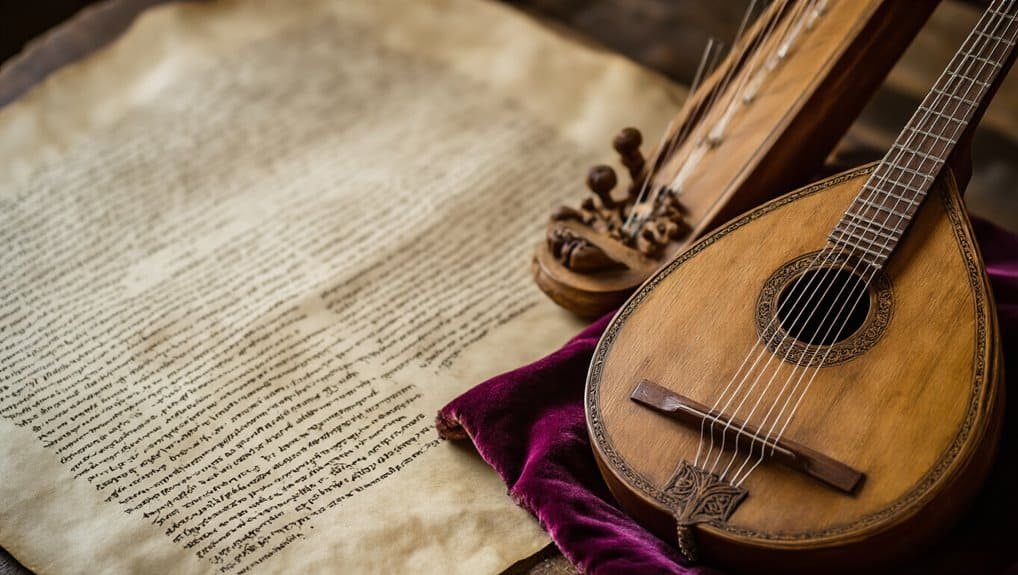
Medieval string instruments emerged during Europe’s Middle Ages (500-1400 CE), revolutionizing musical expression through innovations in design and playing techniques.
You’ll find the rebec’s history particularly fascinating, as this bowed instrument evolved from Arabic origins to become a staple of medieval entertainment. Its pear-shaped body and three strings produced bright, penetrating tones that carried well in both indoor and outdoor settings.
String craftsmanship reached new heights during this period, with luthiers developing specialized techniques for creating gut strings and shaping wooden bodies.
You’ll notice that instruments like the vielle, psaltery, and gittern showcased increasingly complex construction methods. The vielle, ancestor to modern violins, featured a flat bridge that allowed players to sound multiple strings simultaneously.
Meanwhile, the psaltery’s plucked strings laid horizontally across a trapezoidal soundbox, demonstrating medieval artisans’ growing understanding of acoustic principles.
The Evolution of Percussion Through Ages
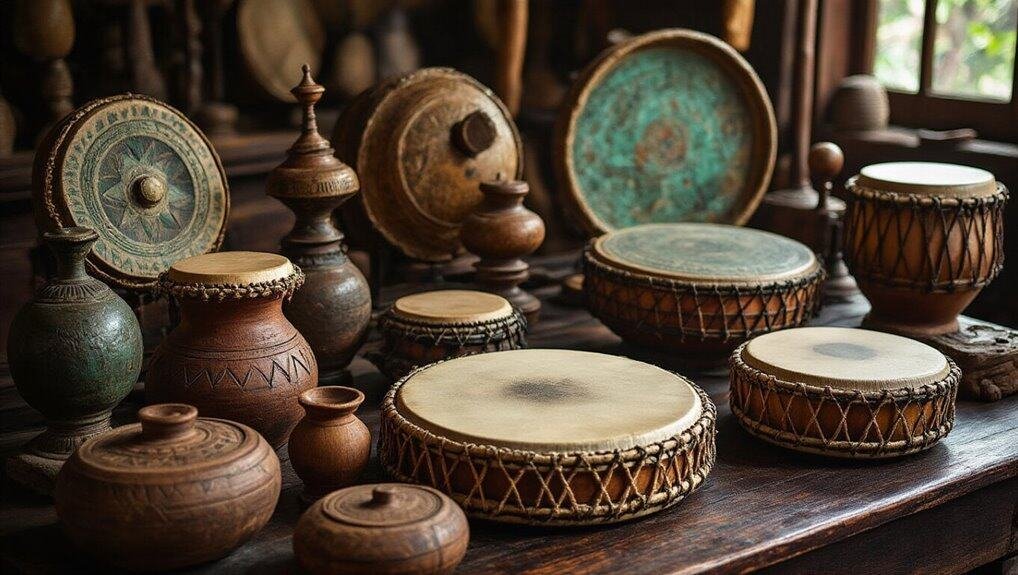
Throughout human civilization, percussion instruments have served as foundational elements of musical expression, with archaeological evidence revealing basic drums and struck implements dating back over 35,000 years.
You’ll find that drum evolution reflects humanity’s ingenuity in crafting instruments from available materials, from hollow logs to animal skins stretched over wooden frames.
In ancient civilizations, you’d have encountered percussion instruments that served both ceremonial and practical purposes. The cultural significance of these instruments extended beyond music-making – they were vital for communication, religious ceremonies, and warfare.
You can trace how Egyptian frame drums evolved into tambourines, while Chinese temple blocks developed into complex orchestral percussion.
Today’s percussion family includes sophisticated instruments you wouldn’t have found in earlier periods, such as the modern timpani with its pedal-tuning system and the marimba with its precisely-tuned bars, demonstrating humanity’s continuous refinement of rhythmic tools.
Chinese Imperial Court Instruments
While many ancient civilizations developed court music, China’s imperial orchestras achieved unprecedented sophistication through their precisely categorized musical instruments.
You’ll find that Guqin history dates back over 3,000 years, with the instrument’s seven strings representing cosmic harmony. The Pipa techniques evolved to include over 50 different finger movements, creating sounds that mimicked everything from thunderstorms to bird calls.
When you explore traditional ensembles, you’ll notice the Erhu significance in connecting melodic passages between instruments.
Imperial music wasn’t just entertainment; it served as a vital part of court performances and state ceremonies. During festival instruments performances, specific pieces were played to honor ancestors and deities.
The music symbolism extended beyond mere acoustics – each instrument’s position, material, and playing technique reflected China’s complex social hierarchy and cosmic beliefs.
Renaissance Musical Innovation
During the Renaissance, you’ll observe the lute’s transformation from a simple four-course design into an intricate instrument featuring up to thirteen courses of strings, with innovations like the chitarrone emerging for enhanced bass accompaniment.
You’ll find that keyboard instruments underwent significant mechanical improvements, particularly in the development of the virginal’s jack-and-quill mechanism that would later influence harpsichord construction.
These advancements in both plucked string and keyboard technologies exemplify the period’s drive toward greater musical expressiveness and technical capability, setting foundations for Baroque-era instruments.
Lute Design Evolution
The Renaissance period marked a pivotal transformation in lute design, as craftsmen refined the instrument’s core elements between 1400-1600 CE.
You’ll find that early lute types evolved from basic four-course designs to more complex instruments featuring up to thirteen courses of strings. European lute making incorporated innovative techniques, including the distinctive bent-front pegbox and cross-grain soundboard bracing.
As you examine period instruments, you’ll notice the shift from lightweight bodies to more robust construction methods. Craftsmen began using thinner ribs of yew or maple, precisely bent and joined to create the characteristic bowl-back shape.
They’d secure these components with animal glue and reinforce the structure with internal bracing patterns, which you can still see replicated in modern reproductions.
Early Keyboard Advancements
Renaissance craftsmen revolutionized keyboard instruments alongside their innovations in lute making, marking a significant advancement in musical technology.
You’ll find that early harpsichord mechanics evolved from simple string-plucking mechanisms to sophisticated systems featuring multiple registers and stop controls. The introduction of the jack action system allowed for precise string engagement and enhanced dynamic control.
In examining clavichord history, you’ll discover that these early keyboards provided musicians with unprecedented control over sound expression. The tangent mechanism, which you’d find striking directly against the strings, enabled performers to create subtle variations in pitch and volume.
While the harpsichord gained prominence in court settings, the clavichord’s intimate sound made it ideal for private practice and composition, particularly in Germanic regions during the 16th century.
The Birth of the Modern Piano
While medieval musicians relied on harpsichords and clavichords, Bartolomeo Cristofori’s groundbreaking invention in 1700 Florence transformed keyboard instruments forever.
You’ll find that his “gravicembalo col piano e forte” introduced a revolutionary hammer mechanism that could produce both soft and loud notes, unlike its predecessors.
The piano evolution accelerated as Cristofori refined his key innovations, including the escape mechanism, which allowed hammers to fall away from strings immediately after striking them.
You can trace how his back check system prevented hammers from bouncing uncontrollably, while his damper mechanism stopped strings from vibrating once you released the keys.
These developments created the foundation for dynamic control that modern pianists rely on today.
Indigenous Musical Treasures
Throughout ancient civilizations, indigenous peoples crafted remarkably sophisticated musical instruments using materials from their local environments. You’ll find hollow logs transformed into drums, dried gourds fashioned into rattles, and river reeds shaped into flutes.
These instruments weren’t just for entertainment; they served as vital tools for tribal rhythms and ceremonial songs that marked important cultural events.
Indigenous music transcended mere entertainment, becoming essential vessels for cultural ceremonies and tribal traditions across generations.
In the Americas, you’ll discover the Native American water drum, which produces unique tones by adding different amounts of water inside its chamber.
Australian Aboriginal peoples developed the didgeridoo, a wind instrument made from eucalyptus trunks naturally hollowed by termites.
In Africa’s diverse regions, you’ll encounter the talking drum, an instrument that can mimic the tonal patterns of human speech.
These innovations demonstrate how indigenous peoples mastered acoustic principles through careful observation and generational knowledge, creating instruments that continue to influence modern music.
Lost Instruments and Archaeological Discoveries
Ancient archaeological digs have unearthed musical instruments that reveal fascinating insights into lost civilizations‘ artistic and technological achievements. You’ll find that these lost artifacts range from bone flutes dating back 40,000 years to sophisticated hydraulic organs from Roman times.
Each discovery provides crucial evidence of humanity’s enduring connection to musical expression.
When you examine these finds, you’ll notice how ancient melodies were created using materials available in specific regions. Archaeologists have recovered clay ocarinas from Mesoamerican sites, bronze bells from Chinese tombs, and ivory lyres from the Royal Cemetery of Ur.
Through advanced acoustic analysis and 3D modeling, you can now hear reconstructions of these instruments’ original sounds. Recent discoveries include a 3,000-year-old Chinese stone chime set and perfectly preserved wooden drums from Egyptian burial chambers, demonstrating how ancient peoples engineered complex musical tools using surprisingly advanced methodologies.
Frequently Asked Questions
How Were Historical Instruments Tuned Before the Invention of Electronic Tuners?
You’d tune instruments using several historical tuning methods, including pure intervals and natural harmonics.
You’d rely on your ear to match perfect fifths, fourths, and octaves. Musicians employed historical temperaments like Pythagorean, meantone, and well-temperament systems.
You’d also use tuning forks (invented in 1711), pitch pipes, or reference notes from fixed-pitch instruments like organs to establish baseline frequencies.
Which Historical Instruments Were Exclusively Played by Women in Ancient Cultures?
You’ll find that feminine performance traditions were particularly strong with instruments like the Japanese koto, where noble women dominated its practice since the 8th century.
The Chinese zheng and Korean gayageum also held cultural significance as women’s instruments.
In ancient Egypt, you’d see women exclusively playing the sistrum in religious ceremonies, while in medieval Europe, the portative organ was often associated with female performers.
What Materials Were Used to Make Instrument Strings Before Metal?
You’ll find that gut strings dominated early instrument making, crafted from sheep or goat intestines through a complex drying and twisting process.
Before metal strings emerged, you’d also encounter silk strings in ancient China and Japan, particularly on their zithers and lutes.
Plant fibers served as gut alternatives, with craftsmen using twisted hemp, flax, or cotton to create durable strings for certain folk instruments.
How Did Weather and Climate Affect the Construction of Ancient Instruments?
You’ll find that climate impact played a crucial role in ancient instrument making, as humidity and temperature fluctuations could crack wood, stretch skins, and warp joints.
Your material choices had to account for local weather conditions – desert regions favored dried gourds and animal skins, while tropical areas used moisture-resistant bamboo and hardwoods.
Coastal builders often treated woods with oils to prevent salt air damage.
How Much Would Rare Historical Instruments Cost in Today’s Market?
You’ll find auction prices for rare historical instruments can range from hundreds of thousands to millions of dollars.
A Stradivari violin typically commands $10-20 million, while rare Guarneri specimens fetch similar amounts. Market demand drives these values higher each year, particularly for authenticated pieces.
The 1741 “Vieuxtemps” Guarneri sold for $16 million, and you’ll see similar instruments reaching comparable prices at prestigious auctions.
Conclusion
You’ll find that historical musical instruments reveal humanity’s perpetual drive for sonic innovation. From Paleolithic bone flutes to Egyptian sistrum rattles, you’re tracing a complex evolution of acoustical engineering. Through examining surviving specimens, iconography, and textual records, you’ve witnessed how each civilization’s technological capabilities and cultural needs shaped their instrumental developments. You’re now able to recognize these artifacts as crucial markers of human achievement in sound production.


No Comments