


05 Sep Christian Bhajan Collection: Songs of Faith and Devotion
You’ll discover Christian bhajans are devotional songs that blend Indian musical traditions with Biblical theology. These unique compositions emerged in the late 19th century, using harmonium, tabla, and call-and-response formats to express Christian truths through culturally resonant melodies. They’re performed in Hindi, Tamil, Malayalam and other regional languages, incorporating both Eastern ragas and Western harmonies. The rich diversity of styles across India’s regions reveals a fascinating intersection of faith and culture.
Key Takeaways
- Digital platforms like YouTube, Spotify, and Christian music websites offer extensive collections of Christian bhajans in multiple Indian languages.
- Traditional Christian bhajans blend harmonium, tabla, and dholak with devotional lyrics expressing Biblical themes through Indian musical frameworks.
- Collections typically include both historical compositions from pioneers like I.J. Swamidoss and contemporary artists like Paul Dhinakaran.
- Regional variations feature distinctive styles from Kerala, Tamil Nadu, and North India, offering diverse worship experiences across cultural contexts.
- Christian bhajan collections combine repetitive choruses, simple melodies, and call-and-response formats suitable for congregational worship settings.
Historical Origins of Christian Bhajans
Christian bhajans emerged in India during the late 19th and early 20th centuries as missionaries and Indian Christian converts sought to indigenize Christian worship through traditional devotional music forms.
You’ll find that these early adaptations drew from multiple historical influences, including Hindu bhajan traditions, Carnatic music patterns, and Western hymnal structures. Indian Christian composers began crafting devotional songs that maintained the spiritual essence of traditional bhajans while incorporating Christian theology and Biblical narratives.
The bhajan adaptations weren’t merely musical transitions – they represented a deeper cultural synthesis. You’ll notice how early Christian bhajan writers used familiar ragas and talas, coupled with local languages and indigenous instruments like harmonium and tabla.
This thoughtful integration helped make Christian teachings more accessible to Indian audiences while preserving their cultural identity. The movement gained particular momentum in North India, where bhajan traditions were already deeply rooted in everyday spiritual practice.
Musical Elements and Instrumentation
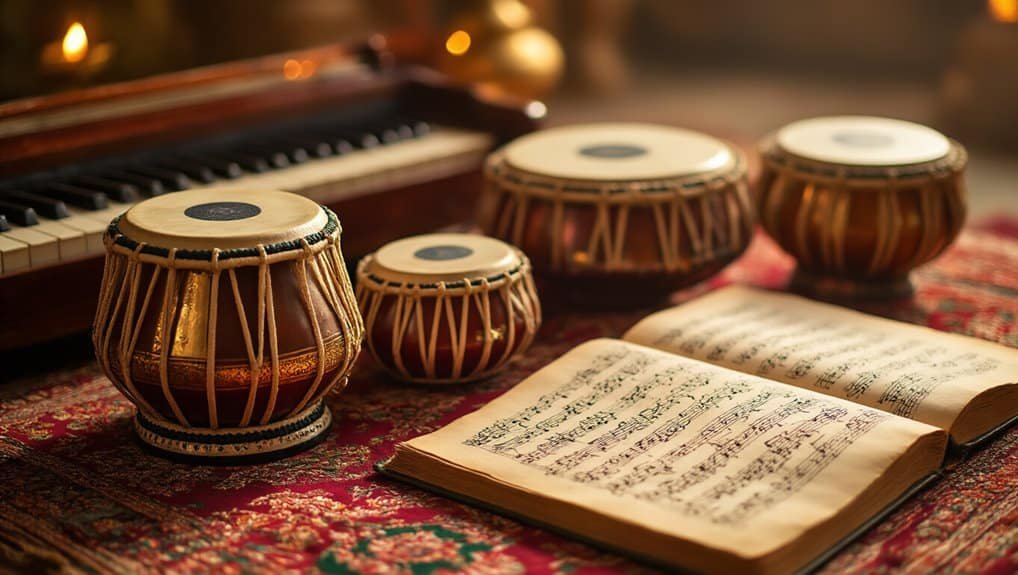
While traditional bhajans rely heavily on classical Indian musical structures, modern Christian bhajans incorporate a unique blend of Eastern and Western musical elements.
Modern Christian bhajans beautifully weave together classical Indian traditions with Western musical influences, creating a distinctive devotional fusion.
You’ll find that these devotional songs maintain the characteristic melodic patterns of ragas while integrating Western harmonies and chord progressions. The rhythmic structures often follow traditional taal patterns but may be simplified for congregational singing.
You’ll notice that instrumentation typically includes the harmonium or keyboard as the primary accompaniment, supported by tabla or dholak for percussion. Many Christian bhajan ensembles also incorporate tambourine, manjira (hand cymbals), and occasionally the guitar.
These instruments create a devotional atmosphere that bridges cultural contexts.
The musical arrangements usually follow a call-and-response format, where a lead singer introduces each line and the congregation responds, making them ideal for participatory worship.
This adaptability has helped Christian bhajans find their place in both rural and urban church settings.
Theological Themes in Christian Bhajans
When you listen to Christian bhajans, you’ll find they express Biblical truths through a uniquely Indian musical and devotional framework.
The theological themes in these songs often center on Jesus as Guru, Savior, and Divine Master while using cultural metaphors familiar to South Asian spirituality.
You’ll notice how these bhajans successfully merge Christian doctrine with bhakti-style devotional expression, creating a authentic bridge between Eastern and Western spiritual traditions.
Biblical Truth Through Song
Many bhajans in the Christian tradition convey profound Biblical truths through their lyrical content, drawing from both Old and New Testament teachings. Through lyrical analysis, you’ll discover how these songs weave scripture-based narratives about creation, salvation, and God’s promises.
The devotional verses often mirror Biblical psalms while incorporating Indian musical elements.
When you engage in song interpretation of Christian bhajans, you’ll find they communicate core doctrinal concepts like Christ’s incarnation, crucifixion, and resurrection using culturally resonant metaphors and imagery.
They’re particularly effective at presenting complex theological ideas in accessible ways, helping believers internalize Biblical teachings through memorable melodies and repetitive choruses.
These songs serve as powerful tools for both worship and religious education in Indian Christian communities.
Cultural-Spiritual Expression Merged
Through the artful fusion of Indian musical traditions and Christian theology, bhajans create a unique sacred expression that resonates deeply with South Asian believers.
You’ll find these devotional songs masterfully weaving biblical narratives with classical ragas and traditional Indian instruments, establishing a profound cultural significance in worship.
When you engage with Christian bhajans, you’re participating in a spiritual connection that bridges Eastern and Western expressions of faith.
The lyrics often incorporate local languages and metaphors while maintaining orthodox Christian doctrine. This synthesis allows you to experience theological truths through familiar cultural forms – whether it’s the use of tabla rhythms, devotional dance movements, or call-and-response patterns.
The result is an authentic form of worship that honors both your cultural heritage and Christian faith.
Regional Variations Across India
Despite sharing common Christian themes, bhajan traditions exhibit distinct regional characteristics across India’s diverse cultural landscape.
You’ll find that regional styles vary significantly from Kerala’s Syrian Christian adaptations to Tamil Nadu’s Carnatic-influenced compositions and Maharashtra’s abhangs-inspired devotional expressions.
Local influences shape these variations through community practices that reflect each area’s folk traditions.
In the North, you’ll notice Hindi and Punjabi musical adaptations incorporating tabla and harmonium, while Southern performances often feature mridangam and veena.
Cultural integration appears in performance settings too – from intimate home gatherings in Bengal to large church congregations in Karnataka.
The lyrical variations you’ll encounter demonstrate how Christian theology meshes with regional languages and poetic forms.
Audience engagement differs by region as well, with some communities emphasizing call-and-response patterns while others focus on meditative listening, each reflecting their distinct cultural heritage in worship.
Notable Composers and Musicians
Several pioneering composers have shaped the Christian bhajan tradition since its emergence in the early 20th century. You’ll find that influential musicians like I.J. Swamidoss and Narayan Vaman Tilak masterfully blended Hindu musical elements with Christian theology, creating devotional songs that resonated deeply with Indian congregations.
Modern composers continue to build on these foundations while incorporating contemporary elements. You’ll notice how artists like Paul Dhinakaran and Vijay Benedict have introduced new instrumental arrangements and harmonies while maintaining traditional influences from both Carnatic and Hindustani classical music.
Their compositions often feature the characteristic bhajan elements – repetitive choruses, simple melodies, and devotional themes – while addressing present-day Christian experiences in India. Many of these composers serve dual roles as worship leaders and recording artists, helping to preserve and evolve this unique form of Indian Christian music through both live performances and studio recordings.
Liturgical Use in Modern Worship
The integration of Christian bhajans into formal church services represents a significant development in Indian Christian worship practices. You’ll find these devotional songs being used strategically throughout the liturgy, from opening praise to communion meditation.
They’ve become particularly meaningful during special festivals and cultural celebrations within the church calendar.
Contemporary adaptations of traditional bhajans reflect ongoing worship innovation, as congregations seek to balance authentic Indian musical expressions with Christian theological content. You’ll notice how worship leaders often incorporate bhajans into multilingual services, creating bridges between different cultural groups within the congregation.
The melodies and rhythms familiar to Indian worshippers help create a sense of spiritual connection while expressing Christian truths through culturally resonant forms. Many churches now include bhajan singing as part of their regular Sunday services, youth meetings, and prayer gatherings, demonstrating how these songs have become essential tools for contextual worship in modern Indian Christianity.
Language and Lyrical Structure
Christian bhajans employ a rich tapestry of languages, including Hindi, Tamil, Malayalam, and regional dialects, making them accessible to diverse Indian communities.
You’ll find that the lyrical analysis of these devotional songs reveals a careful balance between indigenous musical forms and Christian theology.
The structure typically follows a call-and-response pattern, where you’ll hear a lead singer present a main verse followed by congregational repetition.
The language diversity allows worshippers to express their faith through familiar cultural idioms while maintaining biblical authenticity.
You’ll notice that bhajans often use simple, repetitive phrases that build in spiritual intensity, similar to traditional Indian devotional music.
Most compositions feature a central chorus that anchors the theological message, while verses expand on biblical themes using local metaphors and imagery that resonate with Indian Christians’ daily experiences and cultural understanding.
Impact on Indian Christian Identity
Bhajan singing has profoundly shaped how Indian Christians integrate their faith and cultural heritage. When you participate in Christian bhajans, you’re engaging in a unique form of identity formation that bridges Western Christianity with Indian devotional traditions.
You’ll find that these songs help you express your faith through familiar cultural idioms while maintaining biblical authenticity. The impact on cultural integration can’t be understated.
As you worship through bhajans, you’re participating in a distinctly Indian Christian expression that helps resolve the tension between religious and cultural identity. You’ll notice how the musical style, instruments, and devotional approach mirror those found in Hindu bhajans, yet the lyrics proclaim Christian theology.
This synthesis creates a worship experience that feels authentically Indian while remaining firmly rooted in Christian doctrine, helping you navigate your dual identity as both Indian and Christian without compromising either aspect.
Recording and Distribution Methods
Since digital technology has transformed music distribution globally, recording and sharing Christian bhajans has evolved from simple cassette recordings to sophisticated streaming platforms.
You’ll find that modern recording techniques now allow for crystal-clear capture of traditional instruments like tabla and harmonium alongside contemporary elements, preserving the authentic devotional essence while meeting professional audio standards.
Distribution channels have expanded significantly, letting you access Christian bhajans through multiple platforms. You can download them from dedicated Christian music websites, stream them on services like Spotify and YouTube, or purchase physical CDs from church bookstores.
Many ministries have also developed mobile apps specifically for sharing these devotional songs. Regional language versions are increasingly available, and you’ll notice that social media networks have become vital in connecting bhajan artists with their audiences.
Independent artists can now self-publish their recordings, helping preserve and spread this unique form of Christian worship.
Teaching and Preservation Practices
Traditional methods of passing down bhajan knowledge remain vital in today’s digital age, with experienced practitioners teaching newcomers through oral tradition and apprenticeship.
You’ll find that teaching methods often combine memorization of lyrics with proper pronunciation in local languages, alongside instruction in traditional musical instruments like the harmonium and tabla.
As you explore preservation techniques, you’ll notice they’ve evolved to include both ancient and modern approaches.
While handwritten manuscripts continue to be maintained in church archives, you’re now seeing digital recordings, notation software, and online repositories being used to safeguard these sacred songs.
Many Christian communities have developed systematic teaching programs where you’ll learn not just the melodies but also the theological significance and cultural context of each bhajan.
This dual approach ensures that both the musical tradition and spiritual essence of Christian bhajans are preserved for future generations.
Frequently Asked Questions
Can Non-Christians Participate in Singing Christian Bhajans?
You can participate in singing Christian bhajans regardless of your faith background, as music often serves as a bridge for cultural exchange and interfaith dialogue.
While these songs express Christian theology, there’s no religious requirement limiting who can sing them.
The practice aligns with principles of inclusivity in worship, though you should approach it respectfully, understanding the spiritual significance these songs hold for Christians.
How Long Does It Typically Take to Learn Christian Bhajan Singing?
You’ll find that learning bhajan singing typically takes 3-6 months to grasp the basics, though mastery requires years of dedication.
Through regular vocal practices focusing on devotional elements and Indian classical techniques, you can develop your skills faster. Your learning pace depends on factors like musical background, practice frequency, and access to proper guidance.
It’s helpful to start with simpler compositions before advancing to more complex bhajans.
Are Christian Bhajans Performed Outside of Church Settings?
Christian bhajans extend well beyond church walls into various cultural and social spaces.
You’ll find them performed at home prayer meetings, community gatherings, cultural festivals, and family celebrations. Their cultural significance has made them popular at interfaith events, where they serve as bridges between different religious traditions.
Many Christian families also incorporate bhajan singing into their daily devotional practices, creating intimate worship experiences outside formal religious settings.
What Clothing Is Traditionally Worn During Christian Bhajan Performances?
When performing Christian bhajans, you’ll find that traditional attire often blends Indian and Christian elements.
You might wear a kurta or sari with Christian symbols, reflecting the cultural significance of both traditions.
Women typically choose modest, full-length garments in light colors, while men opt for kurtas or traditional Indian shirts.
Some performers add crosses or other Christian emblems to their cultural dress to emphasize their faith.
Do Christian Bhajans Incorporate Western Musical Instruments Alongside Traditional Indian Ones?
You’ll find that Christian bhajans often embrace fusion styles, combining Western instruments like guitars, keyboards, and drums with traditional Indian instruments such as harmonium, tabla, and dholak.
This musical blend reflects the cultural influences that shape modern Christian worship in South Asia. The integration of both musical traditions helps create a unique sound that resonates with local congregations while maintaining the devotional essence of bhajan singing.
Conclusion
When you explore Christian bhajans, you’re witnessing a unique synthesis of Indian devotional music and Christian theology that’s shaped modern Indian Christianity. You’ll find these sacred songs continue to evolve, blending traditional ragas with contemporary worship styles while preserving their theological essence. Through careful documentation and intergenerational teaching, this rich tradition remains vibrant, offering a distinctly Indian expression of Christian faith that bridges cultural and spiritual worlds.


No Comments